
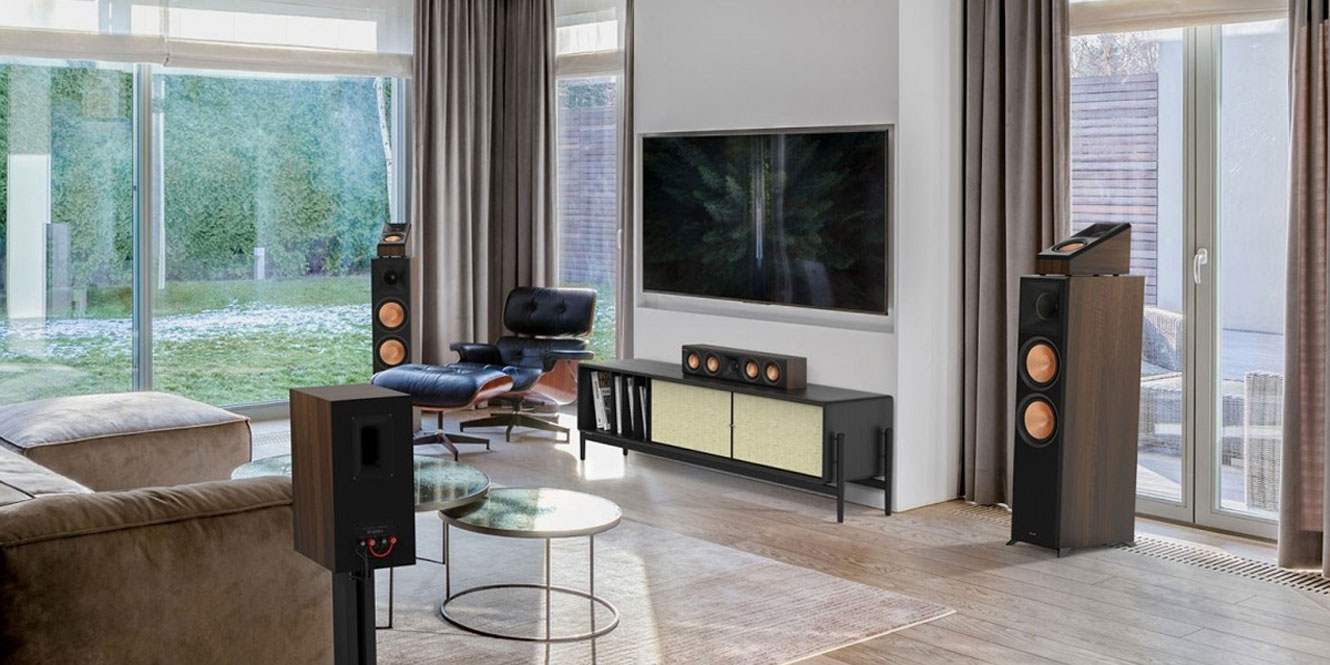

If you want to improve your home theatre experience, you’ll know that Dolby Atmos is the way to go. Its ability to deliver overhead audio makes you feel the excitement of a cinema right in your living room.
However, deciding between up-firing and ceiling speakers for Dolby Atmos can be tricky as they both have many benefits and drawbacks. In this guide, we’ll tackle the debate of up-firing vs. ceiling speakers and provide you with clear insights, so you can decide which one suits you best.
In a Hurry?
Before we get started, here is a glance over the differences between the two speaker types.
| Up-Firing Speakers | Ceiling Speakers |
|---|---|
| Reflects sound off the ceiling down to the listener | Sound comes directly from the ceiling down to the listener for immersive listening |
| Dependent on the acoustics of a room such as the height and slope of the ceiling | Their positional flexibility means they can be strategically placed for optimal sound coverage |
| Can easily integrate into soundbar and speaker systems | Complex installation process |
| Designed to be placed on top/alongside existing speakers | They don't take up any floor space |
Up-firing vs. Ceiling Speakers
Up-firing Speakers
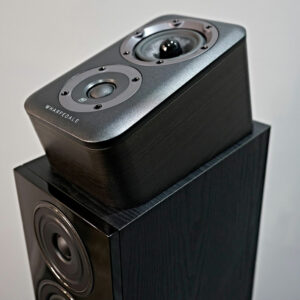 If you’re a newcomer eager to dip your toe into the immersive world of Dolby Atmos, up-firing speakers can serve as a great introduction.
As their name suggests, these speakers are designed to propel the sound upwards. The sound then rebounds off your ceiling and is projected down to where you are sitting, creating the illusion of height.
By leveraging the architecture of your room, up-firing speakers will fill the room with a sound that seems to come from all directions, transforming your living space into a scene from your favourite film.
However, the effectiveness of up-firing speakers depends on the characteristics of your room, especially the ceiling. Ceilings that are too high might not provide the same level of immersive experience, as the sound has farther to travel and may disperse before reaching your listening area.
So, it’s worth considering the acoustics of your living space before getting your hands on an up-firing speaker. Ideally, your ceilings should be flat and 8 to 12 feet high for the sound to bounce effectively.
Up-firing speakers are straightforward to set up. You can position them on top or alongside your speakers – whichever way integrates into your speaker system best – and alter the listening angle to best suit you. Many of these speakers can even be mounted on walls or stands. They’re a fantastic option if you live in a compact living space or prefer a temporary setup.
Price-wise, these speakers vary depending on the brand – but they tend to be more wallet-friendly than ceiling speakers.
Overall, up-firing speakers offer an easy way to bring Dolby Atmos into your home, helping to deliver immersive overhead listening that will make your home cinema viewing that extra bit special.
Our recommendation: Wharfedale D300 3D Surround Speakers
Ceiling speakers
 Unlike up-firing speakers, ceiling speakers don’t project their sound to the ceiling for it to bounce off; they project the sound directly from the ceiling. When it comes to Dolby Atmos, they offer a realistic and enveloping listening experience.
The direct delivery of sound means that every whisper, footstep, and raindrop in a Dolby Atmos track is heard exactly as intended, with precise directionality and placement. This creates an accurate and localised audio effect that is largely unaffected by your room’s acoustics or external interface.
This linear dispersion of sound reduces the loss of audio quality and delivers a more accurate spatial audio experience. They’re brilliant at subtly filling out the space above you that is missed by 5.1 and 7.1 speaker systems.
While we’re on the subject, if you want to integrate ceiling speakers into a multi-directional speaker system, you will likely need an Atmos-capable receiver to go with it.
Ceiling speakers are also a discreet addition to your home decor. Of course, they don’t take up any floor space, so you can enjoy a powerful sound without the annoying clutter of wires.
Most in-ceiling speakers come with white grilles, shielding the drivers from view. A lot of these grilles are also paintable, so you adapt these speakers to suit any shade or colour of your choosing.
Having said that, ceiling speakers don’t come without their downsides. They require you to cut into the ceiling and run cables through the structure of your home, so you may need to seek professional assistance which can be complex and often expensive.
Before installation, you should be certain about the positioning of your optimal listening area. Once you’ve installed the speaker, it’s hard to change it!
Additionally, due to the speakers’ often compact size, you’ll probably require multiple ceiling speakers to broaden sound dispersion. For further guidance, check out our guide to choosing the correct number of speakers.
Our recommendation: Monitor Audio C180 In-Ceiling Speaker
Which One is Better for a Home Cinema?
When it comes to deciding on the best audio setup for a home cinema, particularly when incorporating Dolby Atmos, both up-firing speakers and ceiling speakers bring distinct qualities to the table.
Ceiling speakers stand out for their superior sound quality in a home cinema context. Unlike up-firing speakers, which depend on sound reflections, ceiling speakers deliver sound directly to the listener with greater precision and less interference. This direct path ensures that audio cues in films are heard exactly as intended and makes you feel as if you’re in the heart of the action.
They can also accurately render a three-dimensional sound space much more effectively, a hallmark of the Dolby Atmos experience.
In terms of installation, up-firing speakers are definitely the easiest of the two. Designed to sit on top of or near your existing bookshelf/floor-standing speakers, they bounce sound off the ceiling to simulate the Atmos effect. This setup is less invasive and doesn’t require the same level of commitment as installing speakers in your ceiling.
Up-firing speakers even give you the option to continuously alter their positioning, allowing you to experiment with how you view your favourite films and TV shows.
Price is another important consideration. Up-firing speakers generally offer a more cost-effective entry point into the world of Dolby Atmos. The investment in in-ceiling speakers can be significantly higher, especially when you factor in the potential need for professional installation to achieve the optimal setup.
In terms of aesthetics, ceiling speakers have the advantage of being nearly invisible, blending seamlessly into the room without taking up valuable floor or shelf space. In contrast, up-firing speakers, while still relatively unobtrusive, do add to the physical footprint of your home cinema setup.
Overall, the choice between up-firing and ceiling speakers for a home cinema depends on your own individual tastes and circumstances. If you’re looking for a higher-end Dolby Atmos experience that saves on space, ceiling speakers are a great option. If you’re after a simpler, more cost-effective solution, up-firing speakers are a solid alternative.
FAQs
Do up-firing speakers work with high ceilings?
Up-firing speakers can work with high ceilings, but their effectiveness decreases as ceiling height increases. Optimal performance is usually found with ceilings between 8 and 12 feet, ensuring the sound reflection accurately simulates overhead audio.
Are ceiling speakers best for Atmos?
Ceiling speakers are the best for a genuine Atmos experience. They deliver precise and direct sound from above, offering unmatched immersion and spatial audio accuracy for an authentic home cinema atmosphere.
Where do you put a soundbar with up-firing speakers?
A soundbar with up-firing speakers is best placed directly below your TV. This positioning leverages the vertical space to bounce sound off the ceiling directly to the listener, ensuring optimal sound projection and an immersive audio experience,
Final Thoughts
Ultimately, the discussion of up-firing vs. ceiling speakers for Dolby Atmos rests on what is most suitable for you. Both of these speaker types, however, are more than capable of producing Dolby Atmos and are a great way of adding an extra level of immersion to your favourite films.
If you want to find out more, check out our 5 ways to improve your home theatre or learn how you can transform your spare room into your own personal cinema. You can also drop into one of our showrooms to get a first-hand look at our products!





0 Comments