


The stylus and cartridge are a small but incredibly important aspect of any turntable setup. Without them, you simply wouldn’t get any audio. Cartridges come in two forms: moving magnet (MM) and moving coil (MC), and although the desired end result is the same, the way they go about achieving it is fundamentally different.
So, how do the two differ?
In my head, moving magnet vs. moving coil is a bit like comparing Imperial and Metric measurements. We all have a rough idea of what an inch looks like and could estimate it fairly well, but millimetres are much more precise (an inch is 25.4mm if you’re interested).
Sticking with that analogy, MM cartridges are the “inch” – they’re easier to live with, generally produce a punchier sound, have higher output levels, and are overall simpler to install.
MC cartridges, on the other hand, are the “millimetre” equivalent. They offer incredible detail but tend to be more expensive, quieter in output, and more challenging to set up.
That being said, I’m painting with a broad brush here, but it helps to illustrate the point. MM cartridges have a simpler, more robust design and operation, whereas MC cartridges are more detailed and precise, but also require more care to get the best performance from them.
In a hurry?
| Moving Magnet | Moving Coil | |
|---|---|---|
| Design | The stylus is connected to a small magnet that moves within a fixed coil. | The coil moves across a stationary magnet. |
| Output | 2 to 10mV, typically 3 to 5mV. | 0.15 and 3mV, typically 0.15 to 1mV. |
| Performance | Bold and punchy performance. | Detailed, with more sensitivity to dynamic shifts. |
| Recommended cartridge | Ortofon 2M Blue Moving Magnet Cartridge | Audio Technica AT-OC9XSL Dual Moving Coil Cartridge |
What is a cartridge and how does it work?
A cartridge is the bit at the end of the tonearm that holds the stylus; it’s responsible for turning the grooves in a vinyl record into an electrical signal.
As the record spins, the stylus sits in the groove and picks up tiny movements. These movements travel up through the cantilever and into the body of the cartridge, where they’re converted into a signal your system can use. This happens in both moving magnet and moving coil designs.
Once the signal is generated, it gets sent to your phono stage to be boosted and shaped before heading off to your amplifier and speakers. The stylus shape, cantilever material, and the internal design all play a role in how detailed or dynamic the signal ends up being. It’s a small part of the turntable, but it makes a massive difference to how your records sound.
Moving magnet vs. moving coil cartridges
Design
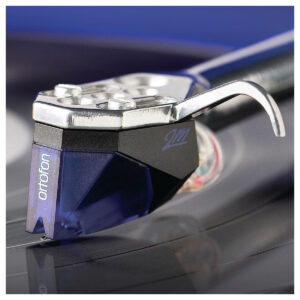 All cartridges work on the same basic principle: a magnetic object moving through a magnetic field creates an electric current. This current then gets amplified and translated into sound, as explained above.
Where moving magnet and moving coil cartridges differ is in which part does the moving. In an MM design, the stylus is connected to a small magnet that moves within a fixed coil.
With the magnet having more mass, it creates a stronger current as it moves, which makes the signal louder and more robust. In contrast, an MC cartridge flips the setup. Here, it’s the coil that moves across a stationary magnet.
The coil is lighter and more responsive, so while it doesn’t generate as much voltage, it can pick up much finer movements. This means better detail retrieval and subtlety in playback but with the trade-off of requiring more precise and often more expensive engineering.
Output
As mentioned earlier, the design directly influences the signal each type of cartridge produces. MM cartridges have heavy-moving magnets, so they tend to generate a stronger electrical current. This results in a louder, “hotter” output, making them easier to pair with standard phono stages and more accessible overall.
Most MM cartridges fall into the 3 to 5-millivolt range, but the full window runs from about 2 to 10mV. This higher output simplifies system matching and helps keep overall setup costs down.
On the other hand, MC cartridges produce a much lower output because the coils that generate the voltage are smaller and lighter. You’re typically looking at a range between 0.15 and 1mV, though some can go up to 3mV. Because of this, MC cartridges need more gain from your phono stage or a step-up transformer.
However, the payoff is in cleaner, more detailed playback, with extra headroom for musical transients and dynamic shifts.
Performance
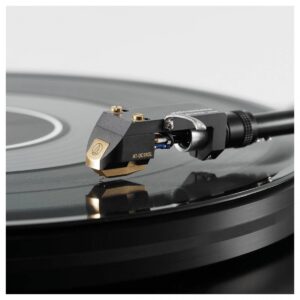 MM cartridges deliver a bolder and more immediate presentation. Their higher output can emphasise punch and energy, which suits casual or lively listening setups well.
The lower output of MC cartridges, by contrast, isn’t a drawback; in fact, it can actually benefit your audio.
With less electrical interference and a greater ability to track fine movements, MC cartridges are more sensitive to dynamic shifts in music. This allows them to reveal textures and microdetails that MM cartridges may smooth over, making them especially suited to critical listening.
You’ll often notice more space between instruments, better articulation in vocals, and a generally more three-dimensional sound.
Moving magnet vs. moving coil cartridges – which is right for you?
It’s all about whether you want finesse and subtlety or a high, strong output.
Choosing between a moving magnet and a moving coil cartridge really depends on how you listen and what kind of setup you’re working with. If you’re after something straightforward that gives you a bit more volume straight out of the box, a moving magnet cartridge makes a lot of sense.
MM cartridges are easier to pair with most standard phono stages, they’re more affordable, and they give you a sound that’s full of energy and presence. Basically, they’re perfect if you’re just getting into vinyl or want something that works without much extra kit.
Moving coil cartridges are a bit more involved, but they offer more in terms of sonic detail. You’ll need either a high-gain phono stage or a step-up transformer to get the best out of them, but the payoff is a cleaner, more refined sound. If you’re chasing detail and depth in your records and you’ve got the gear to match, MC might be the way to go.
Cartridge recommendations
Ortofon 2M Blue – moving magnet
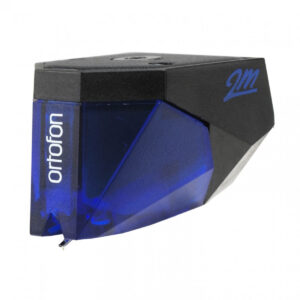
- Nude elliptical diamond stylus
- More open and dynamic sound presentation
- New design with an increased output of 5.5mV
Audio Technica AT-OC9XSL – moving coil
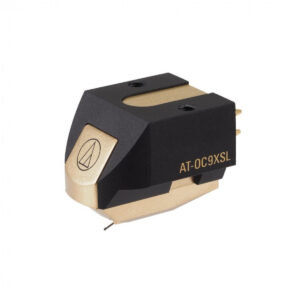
- Frequency response of 20Hz – 50kHz
- Neodymium magnet and permendur yoke
- Pure Copper by Ohno Continuous Casting process (PCOCC)
FAQs
Which cartridge is better, MM or MC?
Neither MM nor MC cartridges are strictly better, as it depends on your setup and listening preferences. MM cartridges are easier to match with most systems and offer bold, lively sound. MC cartridges, on the other hand, reveal more detail and subtlety but need more precise amplification.
Can you use a moving coil cartridge on any turntable?
Moving coil cartridges can’t be used on any turntable as they tend to require a phono stage with more gain or a step-up transformer to work properly. While the cartridge may physically fit, your turntable and phono stage need to be compatible with the lower output signal that MC cartridges produce.
How much gain is needed for an MM cartridge vs. MC?
MM cartridges typically need around 35 to 45 dB of gain, while MC cartridges usually require more, somewhere between 55 and 70 dB, depending on their output level. Lower-output MC models will need the higher end of that range to perform properly.
Final thoughts
When it comes to vinyl and choosing a stylus, it really comes down to personal preference and what you’re hoping to achieve. If you’re just getting started with turntables and swapping cartridges, sticking with MM makes the most sense. It’s also the better option if you’re looking for a simpler setup, and there are plenty of excellent MM cartridges that offer impressive detail and clarity.
On the other hand, if you’re aiming to optimise your vinyl listening setup and are equipped to meet the demands of an MC system, including a higher-gain phono stage, the results can be well worth it. The increased nuance and detail can be remarkable.
If you’re interested in the Ortofon range, we have an article that explains the differences between the cartridges. You may not want to start with the 2M Blue if you’re new to vinyl – the 2M Red is a more accessible entry point. If you want to upgrade, the Bronze and Black are strong contenders.
That said, you might simply prefer the sound of one type over the other, and that’s just as valid. Personally, I’d rather enjoy a high-quality MM cartridge like an Ortofon Black or Bronze than switch to an MC system. But that’s just me.








0 Comments