
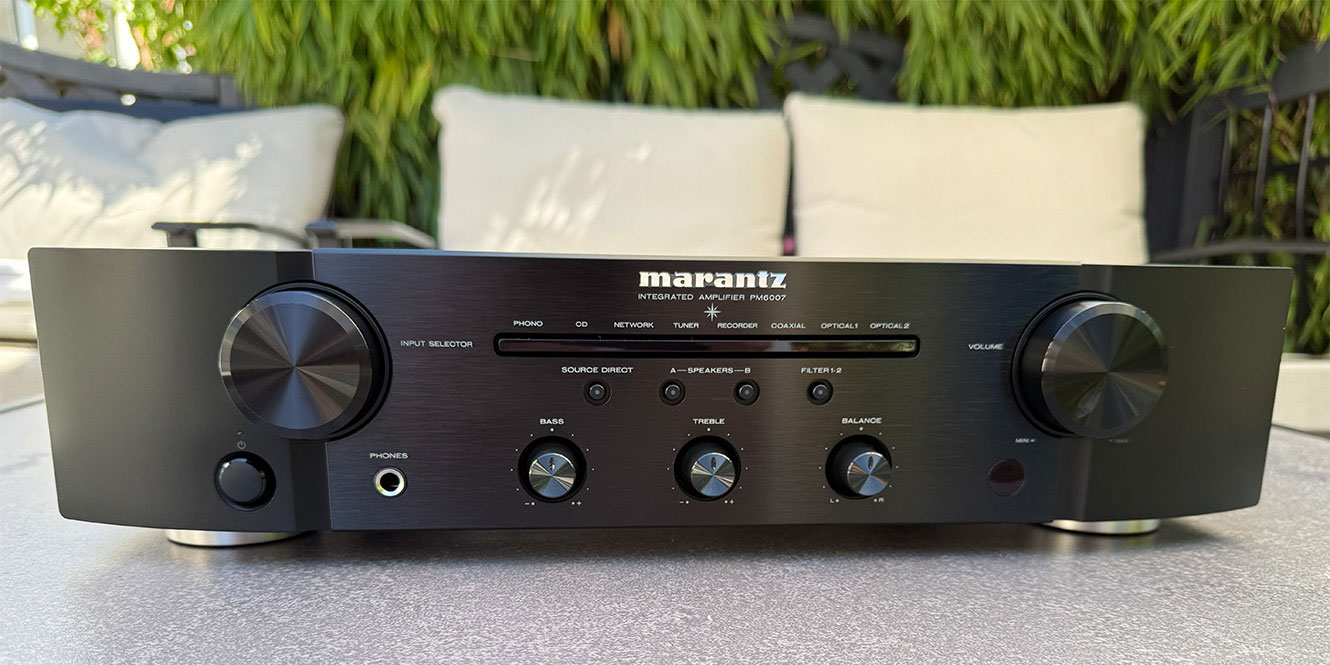

Well, the time has finally come to write about old reliable: the Marantz PM6007.
If you read my guide to the best stereo amps a while back, you might remember me calling this the “default amp option”. I stand by that. If someone asked me to picture a classic stereo amp, the PM6007 is pretty much what my brain conjures up. Simple front panel, proper knobs, useful inputs, no unnecessary nonsense. It’s a certified gem.
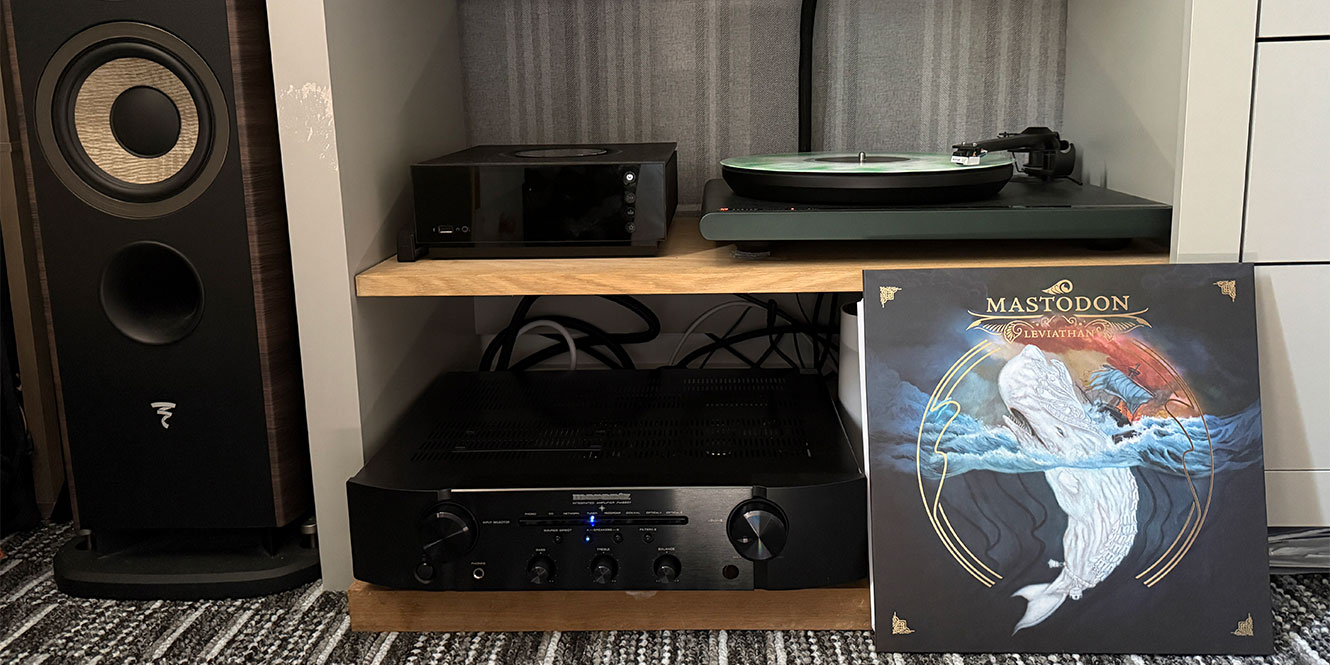
For this Marantz PM6007 review, I swapped it into my usual system in place of my Naim Atom. The setup comprised my Roksan Atessa turntable running into the PM6007 with AudioQuest Red River RCA cables, then out to my Focal Aria 926 floorstanders using AudioQuest Type 4 speaker cable.
The rest of the system is fairly high-end, so the idea here is to give the Marantz a proper chance to show what it’s doing, rather than judging it in a setup that holds it back.
Straight away, this isn’t a direct fight with the Naim. The Atom costs a lot more and does a lot more. But using it as a reference point makes the PM6007 easier to place, especially if you’re wondering how much amp you actually need.
In a hurry? Here’s our verdict
If I had to sum up the Marantz PM6007 in one word, I’d probably go with “friendly”.
It’s a little warm and dark out of the box, but I don’t mean that as a criticism. At this price, I’d rather have an amp that plays nicely with most speakers and sources than one that tries to sound overly sharp and impressive for the first five minutes. The PM6007 is powerful enough for sensible hi-fi setups, nicely articulate, and very easy to live with.
It’s a bit like your childhood dog. It might not have the same get-up-and-go as some flashier options, but it knows what it’s about. There’s a comfort and familiarity to it.
| Pros | Cons |
|---|---|
| Warm, easy-going sound that suits lots of systems | If I'm being picky, the detail and separation could be better |
| Good value for a proper stereo amp | No built-in streaming or Bluetooth |
| The built-in phono stage is genuinely useful | |
| Solid build with a reassuring weight | |
| Simple controls and plenty of everyday inputs |
Marantz PM6007 review
First impressions
In a word: lovely.
I already knew the PM6007 well enough to have a pretty good idea of how it would perform, but unboxing a fresh one was still a nice little moment. It has a satisfying heft when you lift it out of the box, although most of the weight does sit over to the right-hand side. Not a problem, just something you notice when you pick it up.
The input selector switch is subtly notched, and the volume dial has minimal give while offering a smooth rotation; it’s very tactile.
Once it was set up, it looked exactly how I wanted it to look. No screen trying to do too much, no app setup, no feeling that I needed to update anything before listening. Just plug in your sources, connect your speakers, pick an input, and off you go. I know it’s a small and niche thing, but you get a nice, satisfying relay click when you press the on button; all round, it’s very nice.
Build quality and aesthetics
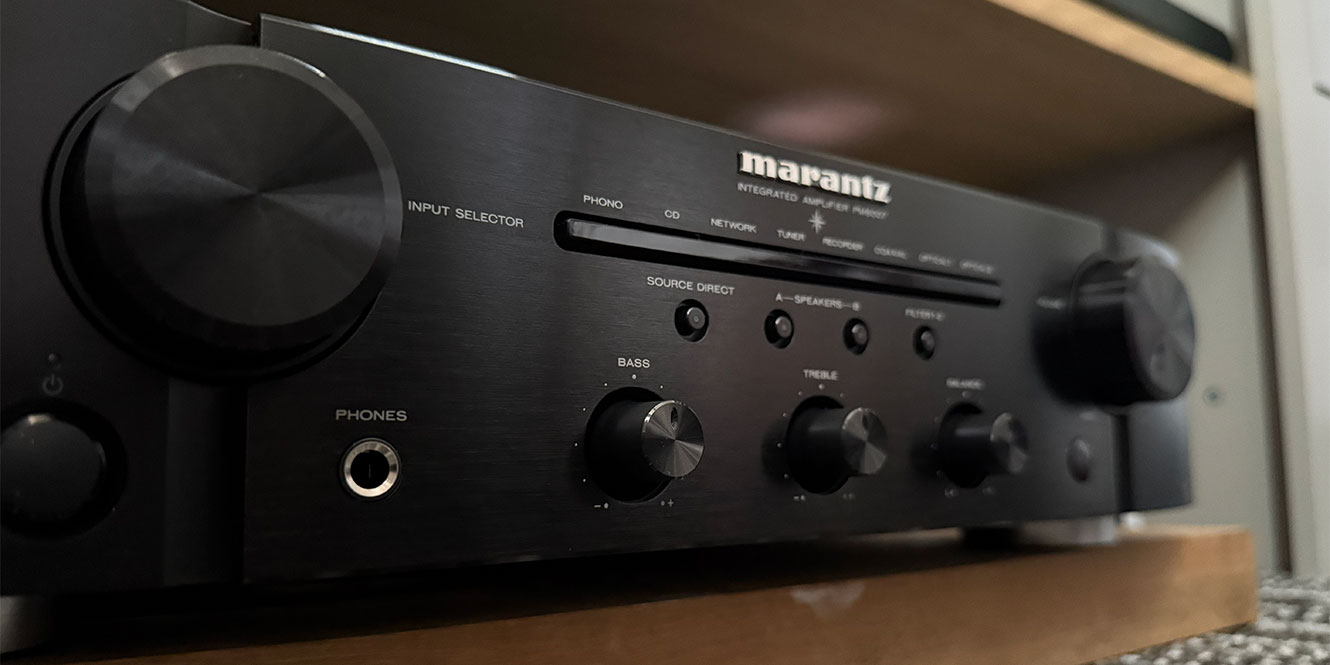
The PM6007 feels nice and solid. The chassis has a reassuring weight to it, and when I carried it with my fingers underneath and thumbs over the top, the top panel didn’t feel like it was flexing or bending under pressure. That sounds like a small thing, but it does make the amp feel a bit more substantial.
It has quite a busy front panel, but it doesn’t feel too much; it’s both feature-packed and pretty.
Design-wise, it’s classic Marantz. If you’ve seen the PM6006, this won’t feel like a wild redesign. It’s more of a small refinement than a full visual reset, with the same clean front panel, central controls, and slightly old-school hi-fi look. Weirdly, the black finish looks blacker to me than I remember on the older model. That might not be technically true, or even make sense, but it does. It looks blacker. I stand by it.
All round, it has a very ’80s-’90s aesthetic about it, which adds to the amp’s charm and really fits how it sounds.
Features
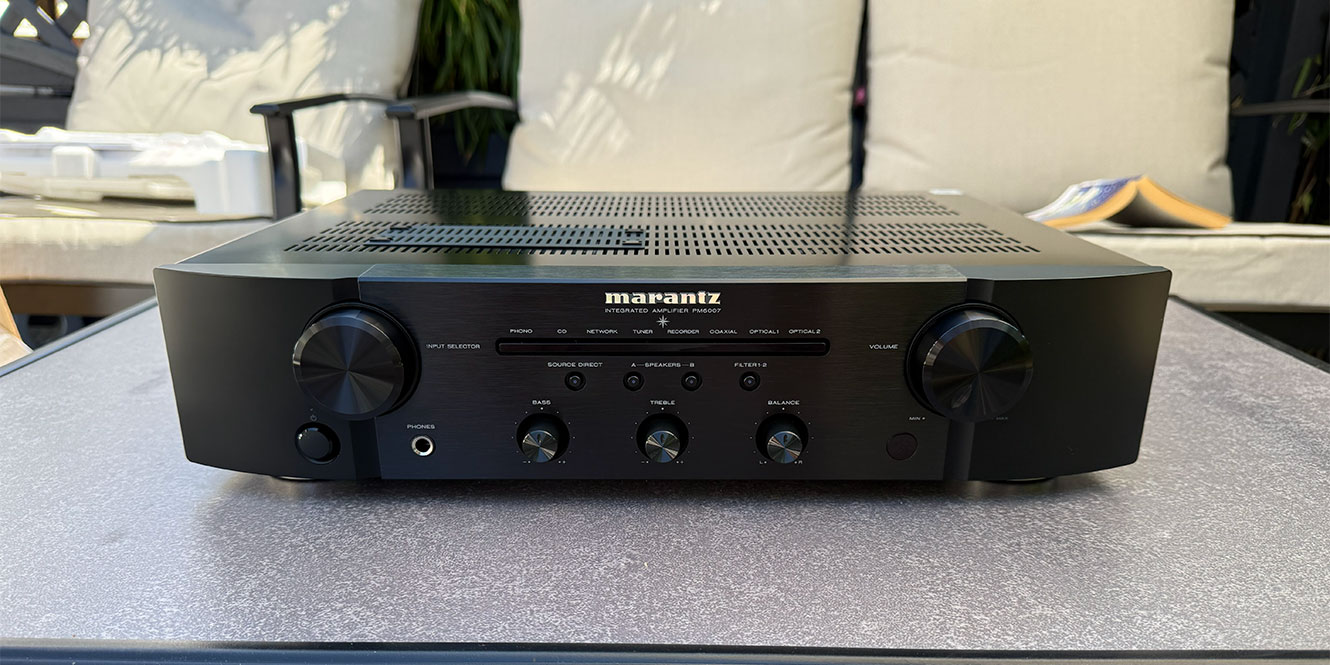
The PM6007 is a relatively simple amp, and I mean that in a good way. There are no big tricks up its sleeve, no app ecosystem to learn, and no streaming platform trying to be the centre of your life. It’s a proper integrated stereo amplifier that does the important stuff well.
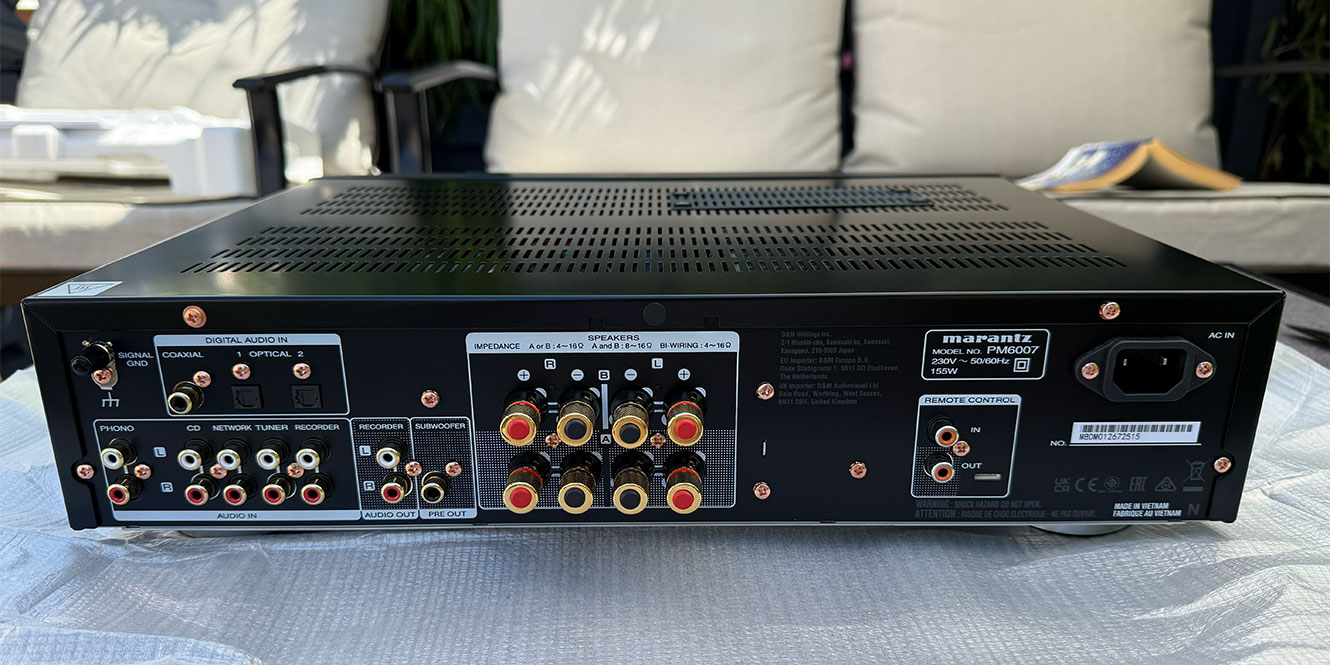
Around the back, you get five analogue inputs, a moving magnet phono input, two optical inputs, and one coaxial digital input. Those digital inputs support up to 192kHz/24-bit playback, so you can run a CD transport, TV, or streamer into it without needing a separate DAC straight away. Marantz also rates the PM6007 at 45W per channel into 8 ohms, or 60W into 4 ohms, which is plenty for sensible home hi-fi setups.
There are also A/B speaker terminals, which give you the option of switching between two pairs of speakers or running a second pair in another room if your setup allows for it. You get bass and treble controls on the front too, although I spent most of my time with Source Direct switched on, bypassing that section entirely.
Compared with the PM6006, the PM6007 feels more like a careful refinement than a dramatic rethink. The big update is the newer AK4490 DAC, replacing the Cirrus Logic CS4398 used in the older model, alongside selectable digital filters for optical and coaxial sources.
Really, its appeal is that it knows exactly what it is. It’s flexible, reliable, and not trying to be anything more complicated than it is.
Sound quality
Sonically, the PM6007 is quite dark. Or warm, depending on which side of the hi-fi synonym fence you prefer. Either way, I don’t mean that as a bad thing. At this price, I’d much rather an amp lean slightly warm than go too bright and shouty just to sound exciting in a quick demo.
The amp does have bass and treble controls if you want to tweak things, but I spent most of my time with Source Direct switched on. That bypasses the tone controls and keeps the signal path a bit cleaner, which is usually where I like to start before changing anything else in the system.
Most of my testing was done with records. I cycled through Mastodon’s Remission and Leviathan, the Cyberpunk: Edgerunners soundtrack, which is great by the way, Bonobo’s Fragments and Black Sands, Mannequin Pussy’s I Got Heaven, Viagra Boys, and then a decent amount of Global Underground.
What I liked most is how easy the PM6007 is to just leave on and enjoy. It works nicely for background listening, but it’s also good enough that you can sit down and properly pay attention. With the earlier Mastodon albums, where everything is a bit busier and messier, it did lose some separation compared with my Naim Atom. The Atom has more muscle and nuance, but it ought to.
On cleaner productions, the PM6007 was much happier. Bonobo, Mannequin Pussy, and the Edgerunners soundtrack all came through with good balance and a really listenable character — soft and comfortable with a relaxed nature.
The built-in DAC is solid too. The PM6007 uses an AK4490 DAC, and its two optical inputs and single coaxial input can handle digital files up to 192kHz/24-bit, so it’s more than capable of taking a feed from a CD transport, TV, or streamer. It’s not the most exciting digital section in the world, but it does make the PM6007 feel more flexible than a purely analogue amp. Again, I’m comparing it to an amp several times the price, so in isolation, I wouldn’t have much to complain about.
And that’s the main thing with this amp. It’s not trying to stun you in the first 30 seconds. It just gets on with being a very good, very easy-to-like amp.
Who is the Marantz PM6007 suited to?
The PM6007 is probably best suited to someone who wants to get into proper hi-fi without making the amplifier the difficult bit. If you’re more interested in choosing speakers, building a vinyl setup, or just getting a system that feels reliable from day one, this is a very easy amp to recommend.
It also makes sense as a mid-level amp for someone who wants a solid platform to build around. The PM6007 doesn’t lock you into a particular kind of system. Pair it with warmer speakers, and you’ll get a smoother, more relaxed sound. Put it with something a bit livelier, and you can bring out more top-end bite.
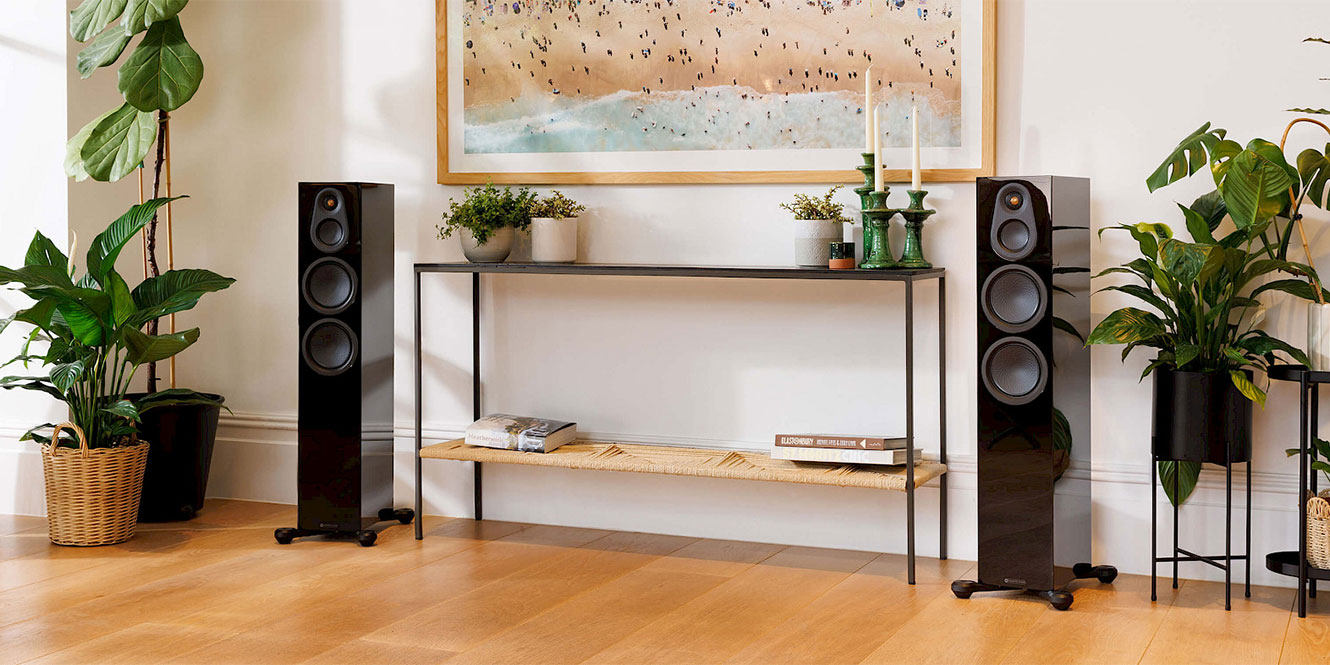
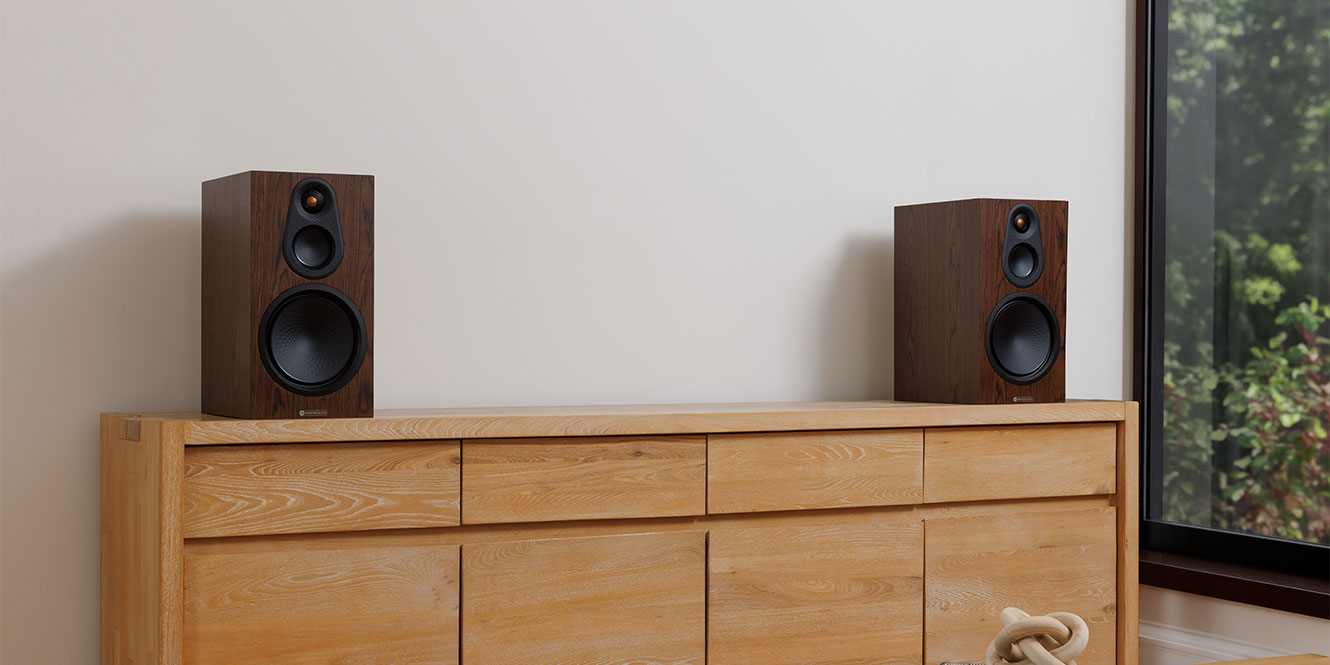
Personally, I think it would sit really nicely with a good pair of DALI or Monitor Audio bookshelf speakers, depending on what you want from the system. DALI if you want things a bit warmer and more easy-going, Monitor Audio if you want more brightness and detail.
It’s not really for someone who wants streaming, HDMI, room correction, or one-box modern convenience. For that, something like the Naim Atom makes more sense. But if you want a straightforward stereo amp that lets the rest of your system shine, the PM6007 is right in its lane.
FAQs
What amp class is the PM6007?
The PM6007 is a Class A/B integrated amplifier. This design delivers a balanced combination of sound quality, control, and efficiency. It produces 45 watts per channel into 8 ohms and 60 watts per channel into 4 ohms.
Can the PM6007 drive floor-standing speakers?
The PM6007 can drive floor-standing speakers. Its 45-watt output into 8 ohms suits many moderately efficient models in small or medium rooms. Speakers with low sensitivity or demanding impedance may need a more powerful amplifier.
How loud is the PM6007?
The PM6007 can play loudly enough for most small to medium-sized rooms. Its 45 watts per channel can produce strong listening levels with efficient speakers. Actual volume depends on speaker sensitivity, room size and listening distance.
Final thoughts
The Marantz PM6007 is exactly the kind of amp that reminds you why straightforward hi-fi still has a place. It doesn’t stream, it doesn’t have an app, and it isn’t trying to replace every box in your system. It just takes your sources, powers your speakers, and does it with a warm, easy-going sound that’s very hard to dislike.
It’s not perfect. Busier music can expose its limits, and if you want the kind of muscle, space, and detail you’d get from something much more expensive, you’ll need to spend more. But that almost feels beside the point. The PM6007 knows what it is, and that’s a big part of why it works.
For anyone building a first proper hi-fi system, upgrading from a basic amp, or wanting something reliable to sit at the centre of a vinyl setup, it’s still a brilliant option. This Marantz PM6007 review has mostly confirmed what I already thought going in: it’s old reliable for a reason.






0 Comments