

If you want to upgrade your hi-fi system, investing in some new speakers is a great first step. Or maybe you’ve recently purchased a CD player and you want to ensure it sounds the best it possibly can.
You might not be sure whether you want floorstanding tower speakers or standmount bookshelf models, but the best speakers for your CD player depend on the kind of sound you’re after: neutral and accurate or dynamic and lively. Below, you’ll find 11 excellent options to suit a range of preferences.
If this is your first step into building a hi-fi system, we recommend exploring what we consider to be some of the best CD players available. You might also want to take a look at our guide to connecting your CD player to an amplifier – we want to make sure you enjoy your hi-fi system properly from the very beginning.
In a hurry?
Here are the absolute best speakers for CD players, in our opinion:
| Wharfedale Diamond 9.1 | You get an impressive amount of speaker for your money here - so much so that it’s hard to recommend anything else that comes close in terms of musical performance at this price point. | Find out more |
| Wharfedale Linton Heritage | For those who want to experience traditional hi-fi speakers that hark back to another era, these will draw you deep into the music. | Find out more |
| Kef Q Concerto Meta | As modern speakers go, very few come close to the Q Concerto Metas. In my opinion, they could be the best speakers ever made pound for pound. | Find out more |
Why we’ve chosen these speakers
We’ve taken a slightly different approach in selecting the best speakers for a CD player, because not everyone uses their speakers in the same way. We could have gone down the audiophile route completely – and we have, with some of our picks – but we’ve also tried to include options for listeners who don’t fit the typical mould.
Because of this, you might spot a few speakers you wouldn’t expect to see on a list like this. But as sound is such a subjective thing, why not?
We’ve chosen speakers that offer standout characteristics. Some, like the Wharfedale Lintons, were an easy decision. Others, like the JBL 4305P wireless studio monitors, are wildcard entries selected for their bold, impactful delivery.
We’ve also considered budget, with 11 different speakers that suit a range of price points. Each one works well with any CD player – whether you’re running an all-in-one unit or a fully separate hi-fi setup.
To my ears, there’s one speaker on this list that ticks all the boxes. You might disagree – and that’s fine. After all, the beauty of listening is that we all enjoy it in our own way.
The best speakers for a CD player
1. Wharfedale Diamond 9.1 Bookshelf Speakers
 Key features
- Multi-award-winning bookshelf speaker
- Exceptional build quality for the money
- Speakers can be bi-wireable for even better musicality
Pros
- Years of pedigree come together to create one of the best budget speakers ever
- Musicality far beyond its price point should ever allow
- Wharfedale ensured it used the Kevlar driver even at this price
Cons
- The vinyl finish is our only gripe, but at this price point, we’re nitpicking
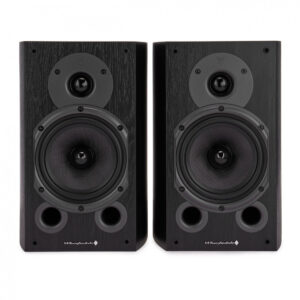
How could we not include the critically acclaimed, award-winning Wharfedale Diamond 9.1 bookshelf speaker? As a budget-friendly option, few speakers can rival its build quality or musicality. This is thanks to the careful design and engineering Wharfedale have refined over generations of speaker development.
Its elegantly curved cabinet sweeps from either side to the rear, enhancing internal bracing and helping to minimise unwanted resonance to an absolute minimum. Retaining Wharfedale’s recognisable driver design, these speakers feature a 130mm Kevlar driver that handles both bass and midrange frequencies.
The 25mm high-frequency tweeter is well-balanced, working in harmony with the Diamond 9.1’s overall tuning to deliver a musically adept sound that punches well above its price point.
Although they’re a little harder to drive – rated at 86dB sensitivity into 6 ohms – their 5.5kg weight adds to the sense of quality. The speaker binding posts also stand out, being bi-wireable for those who want to use a pre-power amplifier setup, which is a welcome option at this price point.
Speaking of power, Wharfedale recommend pairing these speakers with an amplifier rated between 20 and 100 watts. We’d suggest something like the 65W Denon CEOL – an all-in-one mini hi-fi system with a built-in CD player – as a great match.
Musically, these are among the few budget speakers that can deliver both clear, expressive vocals and a solid bassline. The midrange is rich and engaging, and you never feel like you’re missing out, which makes them a strong contender for this lineup.
2. Wharfedale Linton Heritage Standmount Speakers
 Key features
- Retro styling
- Dedicated left and right speakers
- 3-way standmount speaker design
Pros
- Warm musical characteristics with punchy bass
- Incredible clarity and openness
- Enticing stereo imaging, which draws you deeper into the music
Cons
- Grills are fiddly, and you can damage the cabinet removing them
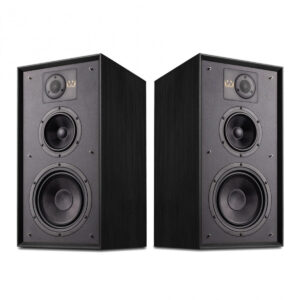
Harking back to another era, the Wharfedale Linton Heritage Standmount Speakers combine a classic, vintage aesthetic with modern engineering. To get the best from them, we’d recommend using the matching Wharfedale Linton speaker stands.
These are true three-way speaker marvels, offering weight and control in musical reproduction thanks to modern acoustic know-how, all while maintaining that retro charm. Their easy-going sonic signature allows them to disappear into the room after only a short listening session, drawing you into the music in a way few other speakers manage. It’s part of the reason so many reviewers end up buying them for themselves.
Designed to be used with their grilles in place, which support the front cabinet baffles, the Lintons feature an unusual visual layout. Each speaker has a right- or left-hand triangular driver configuration, with a centrally mounted 135mm midrange driver flanked by a 25mm soft dome tweeter and a 200mm woven Kevlar bass driver. The off-axis triangle arrangement gives each speaker a unique look, depending on the orientation.
Musically, the Lintons present a warm, expansive soundstage that exemplifies the classic British sound. But don’t assume they’re all smooth and mellow – they pack a punch in the low end too. When paired with well-matched electronics, they deliver bass you can feel, defying what their traditional design might suggest.
3. Kef Q Concerto Meta Bookshelf Speakers
 Key features
- 6.5″ hybrid aluminium bass driver
- 12-generation Uni-Q driver
- Uses Metamaterial Absorption Technology
Pros
- Meta brings reduces unwanted reverberations from the Uni-Q driver
- Dynamic excitable musical signature
- Deep, rich, controlled bass
Cons
- We’re digging for cons, but with such tough competition, we’d say that there could be a little more mid-range detail
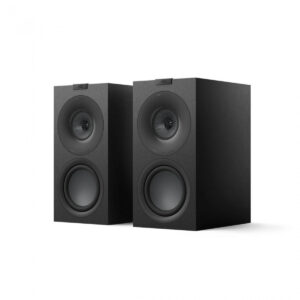
The KEF Q Concerto Meta Bookshelf Speakers exceeded expectations on release, thanks to their well-rounded musical performance. Paying homage to the original Concerto from 1969, the modern Q Concerto retains a 3-way speaker design – just like its predecessor.
Where it differs is in the technology. The Q Concerto Meta features KEF’s 12th-generation Uni-Q driver array, which places a 19mm vented aluminium dome MAT tweeter at the centre of a 100mm aluminium midrange driver. Bass duties are handled by a 165mm hybrid aluminium cone driver, delivering depth and control.
In terms of performance, it competes closely with the KEF R3 Meta, falling just short in extended bass response and overall cabinet refinement. But unless you’ve heard the R3s side by side, the Q Concerto Metas stand impressively on their own – and at a fraction of the cost. In fact, they match the Wharfedale Lintons in many ways, which narrowly edged out the R3 for inclusion in this list.
While the Q Concerto Metas offer a more forward, energetic presentation, what many would describe as a dynamic soundstage, compared to the Lintons’ warmer tone, their capability is undeniable. They simply couldn’t be left out of a list of the best speakers for a CD player.
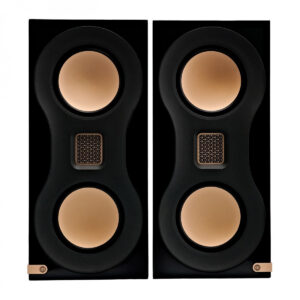
4. Monitor Audio Studio 89 Standmount Speaker
 Key features
- Another speaker built on retro looks with a modern twist
- MPD III tweeter and dual RDT III mid-range drivers
- Compact speaker design
Pros
- Huge soundstage
- ‘Point-source’ mid-tweeter-mid driver array provides exceptional sound quality
- Works well with any genre of music
Cons
- Retro design might not be to everyone’s tastes
The Monitor Audio Studio 89 Standmount Speakers certainly have a Marmite look – and how they ended up that way, especially considering their roots in the 1989 Studio 15, is anyone’s guess.
That said, few speakers have surprised me quite like the Studio 89s. From the moment you lift them onto the matching Studio 89 stands, they feel unexpectedly light for their price point. They may not carry the physical gravitas you’d expect, but they are solid, beautifully built, and finished with Monitor Audio’s signature 10 coats of high-gloss lacquer.
Based on first impressions, you might assume they’re just another smart-looking standmount speaker. But quite simply: they sound outstanding.
Pair them with quality electronics like the Arcam CD5 and Arcam A25, and the Studio 89s come alive. Their dual 108mm C-CAM drivers, used in an MTM (Mid-Tweeter-Mid) layout, deliver bass extension that’s genuinely eye-opening. The midrange is strikingly open and spacious – it’s refreshing to hear.
Add Monitor Audio’s MPD III high-frequency transducer into the mix, and it’s like the icing on the cake. The treble blends seamlessly with the rest of the frequency range, in a way that belies the speaker’s appearance. That’s why it earns its place here – it’s a revelation, offering more than any other speaker we’ve tested in this group.
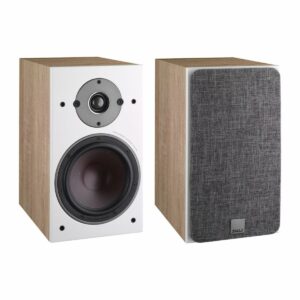
5. DALI OBERON 3 Bookshelf Speakers
 Key features
- Large 7” SMC mid-bass wood fibre driver
- Premium speaker materials
- Wide driver dispersion technology
Pros
- Focused soundstage is significantly better than most expect
- Deep basslines thanks to the 178mm SMC Driver
- Balanced signature with a nicely weighted mid-range focus
Cons
- It’s hard to fault such an accomplished and well-rounded bookshelf speaker
DALI are a brand with a rich legacy, founded by one of the audio industry’s great names – Peter Lyngdorf. The DALI OBERON 3 Bookshelf Speakers continue in the tradition of his design philosophy, reflecting the Danish brand’s commitment to performance and craftsmanship.
As compact speakers, they deliver far more than their size suggests. The build quality is superb, featuring a 178mm wood fibre driver that uses DALI’s SMC (Soft Magnetic Compound) technology to reduce distortion. The soft dome tweeter complements the design, blending seamlessly with the elegant aesthetic of these attractive bookshelf speakers.
One standout feature is the thoughtful design of the grille. DALI voiced the speaker with the grille on – which is rare – but if you want a more lively and dynamic presentation, you may enjoy them more with the grille removed. It’s quite unusual to be given this option without having to rely on room correction software.
If you’re familiar with the DALI signature sound, you’ll recognise it here: powerful bass, detailed highs, and a well-balanced midrange. The soundstage is impressively wide and deep for such a compact cabinet, showcasing just how much effort has gone into its acoustic design.
Despite their small footprint, the OBERON 3s feel reassuringly weighty – a sign that the internal cabinet engineering is doing its part to minimise unwanted resonances. This contributes to the impressive bass performance these speakers are capable of delivering.
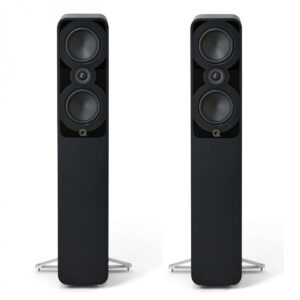
6. Q Acoustics Q 5040 Floorstanding Speakers
 Key features
- P2P cabinet bracing
- Continuous Curved Cone (CCC) design
- Two five-inch mid-bass drivers with a tweeter between
Pros
- Wide soundstage
- Stereo imaging is sublime when set up for the main listening position
- Musical mid-range, which reaches its full potential with equally great electronics
Cons
- Works best with matching or better quality electronics
If you’re looking for a tower speaker that has a degree of excitement while never being over the top, the Q Acoustics 5040 Floorstanding Speakers are for you. Q Acoustics have taken what they learned from the Concept 50s and incorporated some of its best bits, while in other areas even exceeding them.
Because of that, the Q Acoustics 5040s have made it onto this list. While they’re not true 3-way speakers, they do include Q Acoustics’ CCC (Continuous Curved Cone) and HPE (Helmholtz Pressure Equaliser) technologies, which enable them to create a wide and open soundstage.
Using an MTM (Mid-Tweeter-Mid) speaker design brings another level of balance, blending a very strong mid-range performance that extends to a respectable low-frequency point.
Stereo imaging will require a bit of toe-in for the best performance, enabling their three-dimensional sonic ability to fill the listening area with prowess and excitement. Those who want earth-punching bass will be happy to know that these speakers integrate well with an active subwoofer too, which will tickle the bottom end while enhancing the entire frequency range, making them a true match for the Concept 50s.
Musically, there isn’t anything not to like about the Q Acoustics 5040 floorstanders. They look good, perform close to their bigger sibling, and, in some areas, outperform them. They’re perfect for home cinema and CD player setups too, meaning they bring something that few other speakers ever seem to accomplish, and that’s being one of the best all-round speakers you can buy.
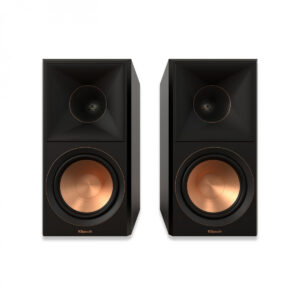
7. Klipsch RP-600M MKII Bookshelf Speakers
 Key features
- 25mm Titanium LTS Tweeter with Tractrix Horn
- Bi-wire/bi-amping option
- 5” Cerametallic driver
Pros
- Far more musically adept than its predecessor
- Detailed mid-range sets it apart from other speakers in this class
- Controlled bass line never becomes boomy
Cons
- Needs careful positioning to hear them at their best
If you’re looking for a fun-sounding speaker that brings a lively musical signature to your CD player, with a forceful vocal presence, the Klipsch RP-600M MKII Bookshelf Speakers are a great option.
Placement is key, as they need to be positioned closer to the rear wall than some of their competition do (the bass can sound thinner than expected). That’s partly due to cabinet resonance issues in the previous incarnation, which Klipsch has now addressed with the all-new MKII cabinet design, delivering a far more controlled bass response.
Now that the bass isn’t as wildly free as its predecessor, this new cabinet design has also allowed Klipsch to redesign the hybrid cross-section Tractrix horn, featuring a 25mm titanium LTS tweeter at its centre. This brings vocals right into the room with a more focused emphasis, and that forwardness adds the excitement Klipsch fans love.
Midrange is another strong point. While some competing speakers may take a different approach, the Klipsch RP-600M MKII follows its own path – never short-changing you in terms of sonic ability, consistently hitting the mark in a way that will appeal to most listeners.
That’s why the RP-600M MKII remains so popular. And for those craving a little more bass oomph, simply add the Klipsch R-121SW to create one of the best 2.1 setups you can buy.
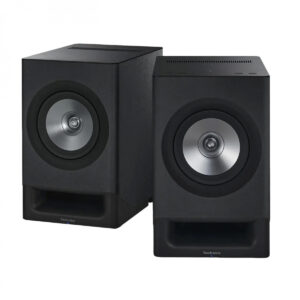
8. Technics SC-CX700B Active Speakers
 Key features
- More connectivity than some of the best hi-fi separates
- Phono-stage and HDMI (ARC) plus 32Bit/384kHz DAC included
- Technics Audio Centre app and Space Tune for room correction
Pros
- It’s like owning a separate hi-fi without the other electronics
- Compact speaker design
- Sounds even better with a subwoofer
Cons
- The smartphone app feels a little sluggish and clunky
Here we have one of the first active speakers to make the list: the Technics SC-CX700. If you’re of a certain age, the name Technics might bring to mind the iconic SL-1200 turntable or the classic hi-fi stacks of decades past.
Finished in Dinamica, a recycled polyester microfibre with the feel of soft suede, the SC-CX700 makes a strong first impression. Even when powered down, it stands out from the crowd with a design that suggests it means business.
As a complete hi-fi solution in a pair of speakers, it’s ready for modern and legacy setups alike. You can connect an MM turntable – perfect if you still own an SL-1200 or plan to pair it with the newer SL-1210 Mk7.
With Optical, USB-C, and HDMI (ARC) inputs, plus a subwoofer output, these active hi-fi speakers are well equipped to modernise a traditional stereo system. You won’t even need to worry about left and right channel placement – Technics include a toggle switch for that, along with a remote for added convenience.
Where these speakers truly excel is in musical detail. They offer an impressively wide and open soundstage, delivering a level of vocal clarity and imaging that many competitors will find hard to match.
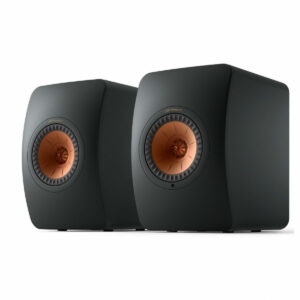
9. KEF LS50W MKII Wireless Bookshelf Speakers
 Key features
- 12th gen Uni-Q with MAT driver array
- Built-in Class A/B and Class D amplifiers
- Compatibility with AirPlay 2, Chromecast, Roon, and KEF Connect app
Pros
- One of the strongest mid-range speakers you’ll hear
- You can experience high-resolution via Bluetooth connectivity
- Speakers can be wirelessly paired when needed
Cons
- Needs the KC62 to hit those ultra-low frequencies
Another active speaker making the list is the renowned KEF LS50W MKII. With few rivals able to compete, it stands apart in this category, offering an exceptional combination of soundstage performance and user-friendly functionality.
Each speaker cabinet features a dual amplifier design, giving the system ample headroom to fully express the capabilities of KEF’s 12th-generation Uni-Q META driver. The result is a level of musicality that’s both precise and expansive.
Unlike many of its peers, KEF were an early adopter in the wireless active speaker space, debuting the original X300A back in 2013. Since then, they’ve refined the experience significantly, now offering one of the most intuitive smartphone apps available, making setup and streaming remarkably straightforward.
You can connect the two speakers wirelessly using KEF’s pairing system, or for the best possible fidelity, simply use the included Cat6 cable, bringing the performance closer to a true high-end stereo system and helping music come alive in the room.
If you’re looking to add extra low-end, the KEF KC62 subwoofer has been specifically designed to integrate seamlessly with this system. A few quick setup adjustments are all it takes to transform the sound into something altogether more powerful.
On their own, these speakers are ideal for anyone seeking hi-fi quality without the usual clutter of separates. Whether you’re connecting a TV or a CD player, HDMI (eARC) and Optical TosLink inputs are both available for straightforward, hardwired connectivity.
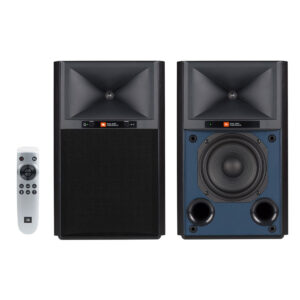
10. JBL 4305P Wireless Studio Monitor Speakers
 Key features
- 300W built-in via a class D amplifier
- High-Definition Imaging horn
- Smart connectivity using Google Chromecast, Apple AirPlay 2, and Bluetooth
Pros
- Can replicate that live sound signature in your living room
- Bass is larger and more impactful than you might think
- The DAC is great
Cons
- They certainly get the ugly duckling award, but close your eyes, and they’re immense at what they do
Designed to recreate the feel of a live soundstage, the JBL 4305P Wireless Studio Monitor Speakers mark a new direction for JBL in the consumer market. At this price point, they’re entering a competitive space filled with world-class brands.
Rather than following the typical hi-fi approach focused on nuance and refinement, JBL takes inspiration from the live performance world. Drawing on their experience in professional concert systems, they’ve created a speaker that offers something quite different from the delicate, sparkling sound often favoured by audiophiles.
These speakers are weightier in tone and deliver a punch that’s unmatched in this lineup. They hit with real force, especially in the low end, bringing kick drums and basslines to life with a boldness that’s more akin to a live gig or a well-balanced band setup at your local venue.
It’s true that most recordings aren’t live, but that doesn’t stop the 4305Ps from filling a room with the same energy and presence. They’re built for listeners who want their speakers to make a statement – sonically and physically.
At this price, few speakers hit the mark quite like the JBL 4305Ps. They won’t be for everyone, and that’s fine. But if you’re drawn to the energy and atmosphere of live music, these active monitors offer a level of realism and excitement that’s hard to beat.
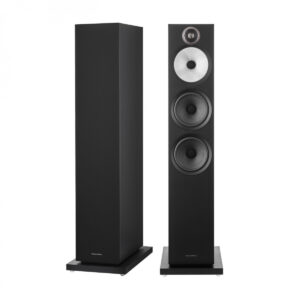
11. Bowers & Wilkins 603 S3 floorstanding speakers
 Key features
- Three-way Flowport vented speaker design
- Continuum cone FST midrange driver
- New Titanium Dome tweeter
Pros
- Dual 6.5″ paper bass cone drivers deliver rich sound
- Focused soundstage that’s both natural and forward
- Reproduces vocals beautifully
Cons
- Amplifier choice is important to enjoy these speakers at their best
How do you define the signature sound of a speaker? Most would say a speaker should aim for neutrality, while adding just a touch of sparkle, particularly in the vocal range, and that’s exactly what the Bowers & Wilkins 603 S3 Floorstanding Speakers deliver.
With over one million units of the 600 Series floorstanders sold since their introduction in 1995, the popularity speaks for itself. Each evolution has offered meaningful improvements, with every new model building on the last in a way that allows it to stand confidently on its own.
This latest generation of the 603 S3 carries the kind of well-balanced hi-fi signature that audiophiles seek. It borrows acoustic technologies from the more premium 700 Series, while a completely redesigned cabinet and increased weight add a greater sense of substance and refinement to the familiar 600 Series DNA.
In terms of pairing, the sonic character shifts depending on your choice of amplifier. Paired with the Arcam A25, the speakers offer a touch more sibilance and sparkle – intentionally so, to highlight those subtle details.
On the other hand, matching them with the Audiolab 9000A smooths out that upper frequency edge, creating a more neutral sound. This flexibility means the 603 S3s can be tailored to your personal listening preferences – exactly what a true hi-fi speaker should allow for.
Whether you’re playing music from a CD or streaming digitally, choosing the right amplifier to suit your taste ensures that these speakers bring your music to life – and, as all great speakers should, disappear into the room.
How to choose the best speakers for your CD player
The hardest thing to define in any personal hi-fi system is what you, the listener, truly want from it. There’s no wrong answer – it’s entirely subjective – and that means there’s a system out there for everyone. No two people hear music in exactly the same way.
First, choose a handful of CDs that you enjoy. These should be songs you know like the back of your hand. At this stage, sound quality isn’t the priority – it’s about getting to know your new setup, which will hopefully help you hear your music in a way that feels unique and personal.
You might be looking for more bass, clearer vocals, or perhaps you’re not sure what to expect. My biggest piece of advice? Pick one of those well-worn CDs, pop it into the player, and choose a track you know inside out.
The right speakers should present something new in the track that you haven’t heard before – this could be subtle, especially if you’re upgrading from an existing hi-fi system. But don’t be surprised if it feels as though a veil has been lifted. If nothing stands out, it might be worth trying a different pair of speakers.
Eventually, there should be a moment where you stop analysing the sound and simply start hearing the music. It should feel like you’re experiencing the track for the first time all over again.
When that moment comes, you’ve found your sound. At that point, it’s also worth considering the rest of the system – amplifiers, sources, cables – because they may be playing a bigger role than you think. Add them to your shortlist for future upgrades.
What else will I need for my hi-fi system?
This largely depends on the type of speakers you’ve chosen. If you’re using a traditional passive speaker setup – either with separate components or an all-in-one stereo receiver – you’ll need a good pair of speaker cables to connect them to your amplification source.
For passive standmount speakers, you’ll also need a pair of speaker stands. These not only elevate the soundstage to ear level for more natural listening, but also provide stability and isolation. A well-designed set of stands can reduce unwanted resonances that might interfere with the speaker’s performance. Some models even allow you to fill them with materials like sand to create an even more solid foundation.
Using stands also allows you to position your speakers more precisely. You can toe them in and adjust the spacing to optimise stereo imaging and musical clarity from your main listening position. A general rule of thumb is to form an equilateral triangle between the speakers and your seat – this applies equally to floorstanding speakers and active models.
If you’re using passive speakers and planning to connect a CD player, remember that you’ll still need an amplifier. A CD player alone won’t power your speakers. Whether it’s a separate integrated amplifier or an all-in-one receiver, some form of amplification is essential. On the other hand, if you’ve opted for active speakers, you can connect your CD player directly – provided the speakers offer the right inputs.
FAQs
Can you connect a speaker to a CD player?
If you are using active speakers and both the speakers and CD player have the correct connections, you can connect them to a CD player. Otherwise, you cannot connect a speaker to a CD player unless you have an all-in-one receiver with a built-in CD player.
Do I need an amplifier for my CD player?
This is a common question, and the answer is usually yes – unless you’re using active speakers or an all-in-one system that includes a built-in CD player and amplification. Most CD players output a line-level signal, which needs to be amplified before it can drive a pair of passive speakers. This means you’ll need either an integrated stereo amplifier or a receiver to complete your setup.
What’s the best connection for a CD Player to an amp?
In a traditional separates setup with passive speakers, most people prefer to use the CD player’s internal DAC (digital-to-analogue converter) rather than the one found in some integrated amplifiers. Because of this, analogue connections – typically via RCA cables – are usually the preferred choice.
Final thoughts
We know there are plenty of speaker options out there – and yes, I’m glad to have included a few wild-card choices in this list, as mentioned at the start. Having been around long enough, I can confidently say that when it comes to finding the best speakers for a CD player, there’s no one-size-fits-all solution.
That said, the top three speakers on this list are, without question, aimed squarely at music lovers – and each one offers exceptional performance at its respective price point.
If you’re after world-class budget speakers, the Wharfedale Diamond 9.1 is an obvious pick. For those who prefer a laid-back, warmer sound signature that still delivers real punch, the Lintons are hard to beat. And for everyone else, the KEF Q Concerto offers a wonderfully balanced all-rounder, giving you just about everything you could ask for in a modern hi-fi speaker.




0 Comments