
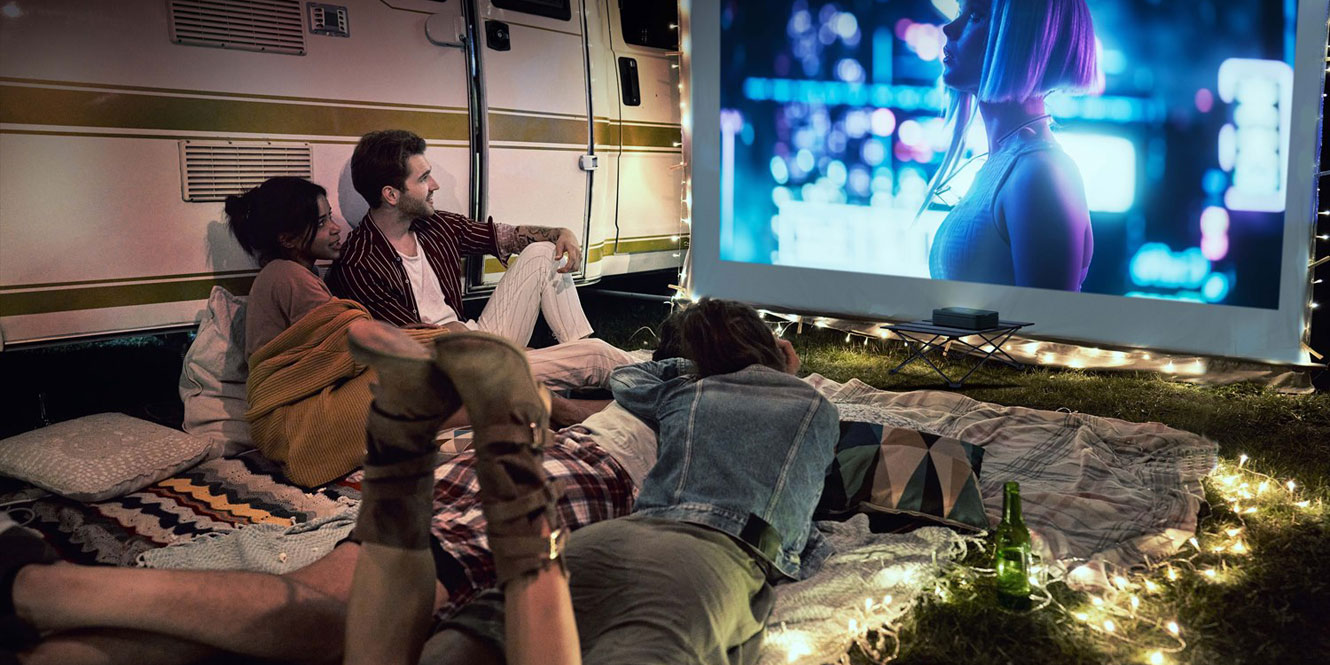

Whether you’re enjoying a film at home or leading a presentation in the office, a projector can come in very handy when you need a good-quality picture. Being obsessed with home cinema and anything audio-visual, our team here have come across all kinds of projectors in our time, and many of them have been small, easy to set up, and easy to transport.
If you’re looking for something that can serve you well in various environments, this list of the best portable projectors is for you. We’ll go through our top picks on the market and explain how to choose the right one for you in our buying guide at the end of the article.
In a hurry?
Here are our top three options:
| Hisense C2TUK Ultra 4K Trichroma Smart Mini Projector | Nothing really matches this portable projector. | Check the current price |
| Epson EF-12 Full HD Mini Laser Short-throw projector | Widely regarded as the best in class, it delivers everything you need from a portable projector. | Check the current price |
| Optoma Photon Go Portable Ultra Short Throw Projector | This can be used anywhere as long as you have a smartphone, 5G connection, and a wall. | Check the current price |
Why we’ve chosen these portable projectors
Each projector on this list had to meet a specific set of criteria to make the cut. First, we wanted to make sure we covered a good price range. We recognise that everyone’s definition of ‘budget’ differs, so we’ve included portable projectors to suit various price points.
With so many options on the market, we’ve further refined our selection based on what people actually want – many of these portable projectors are highly rated by both users and reviewers.
Importantly, they all needed to be easy to pack away. This meant opting for certain light engines, such as laser or LED, to minimise maintenance. After all, nobody wants to replace a failed UHP lamp after only a few uses.
Whether you’re buying for the World Cup, gaming with friends, or simply want to supersize your TV experience for the occasional blockbuster or drama, we’re confident that one of these portable projectors will meet your needs.
The best portable projectors
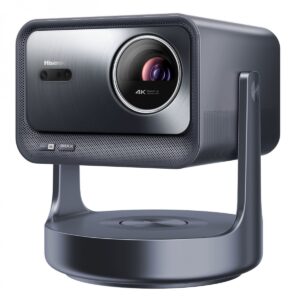
1. Hisense C2TUK Ultra 4K Trichroma Smart Mini Projector
 Key features
- 4K, laser
- 3000 lumens
- 135-degree vertical rotation
Pros
- Vibrant lifelike colours
- Impressive built-in audio
- Gaming performance
Cons
- Remote lacks backlighting
First in this very eclectic lineup is the Hisense C2TUK Ultra 4K Trichroma Smart Mini Projector. It’s not as small as others, or battery powered., but it’s still portable and highly spec’d, with a JBL audio speaker system, smart TV streaming ability, 4K (3840x2160px), and 25,000 light source lifetimes.
With RGB Pure technology built in, the C2TUK Ultra uses Hisense’s 28 precision laser chips to produce 3,000 ANSI lumens, which are reflected off the DMD and e-shifted via a 4K DLP chipset onto your screen. The laser technology uses Hisense’s triple colour laser technology to bring 1.07bn colours, bettering the 4K BT.2020 industry by 10%.
Thanks to its clever gimbal design and optical zoom system, setup is straightforward, with 360° horizontal and 135° vertical adjustment. Auto-keystone correction helps eliminate trapezoidal distortion, while the optical lens offers a 1.67x zoom ratio, enabling true large-screen 4K viewing (from 65 to 300 inches) in a range of settings.
Sound is also something to shout about. This projector is specially tuned by JBL and uses DTS Virtual: X premium audio encoding. Better still, it excels at gaming thanks to MEMC (Motion Estimation, Motion Compensation technology), low-latency, and a 240Hz screen refresh-rate features, making this the best portable projector, in our opinion.
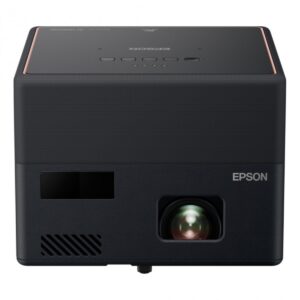
2. Epson EF-12 Full HD Mini Laser Short-Throw Projector
 Key features
- Energy-efficient laser light engine
- 3LCD technology
- Online streaming and casting
Pros
- Very easy to use
- Great sound quality
- A nice, compact design
Cons
- Gaming performance latency is not the best in class
The Epson EF-12 Full HD Mini Laser Short-Throw Projector is quite a strange-looking projector and a little reminiscent of the Sim2 Domino series with its two-tier level design.
Despite being a Full HD model, it impressively matches the C2TUK Ultra in colour performance. Using Epson’s 3LCD technology, it delivers 1,000 lumens at peak brightness and covers 91% of the REC.709 SDR colour standard. Its 3-chip 1920x1080p design adds noticeable texture to films and TV shows, similar to Epson’s dedicated home cinema range.
The EF-12 also features a Yamaha-tuned audio system and Android TV – both important for it to qualify as a portable projector. With a 10-year light source lifespan, the ability to project images from 30 to 150 inches, and a “project onto any surface” claim, it holds broad appeal.
Built-in Android Chromecast makes it easy to cast content from smartphones, Macs, or PCs. And with access to thousands of shows, films, and games via Google Play, it offers solid streaming functionality.
While it lacks a battery for true outdoor use, Epson clearly understood the brief. That omission aside, this is a well-rounded projector and a strong runner-up in this lineup.
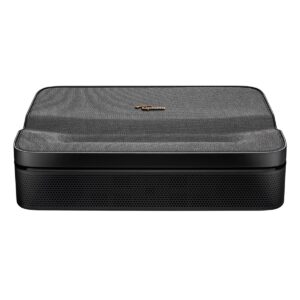
3. Optoma Photon Go Portable Ultra Short Throw Projector
 Key features
- RGB Tri-laser technology
- Google TV software installed
- Auto keystone and focus correction system
Pros
- Lightweight and compact design
- Screen size of 100” from just 25cm
- Google TV built-in
Cons
- Not 4K
The Optoma Photon Go Portable Ultra Short Throw Projector is a truly portable projector that gives up to 90 minutes of TV or film playback from a single charge, or continuous viewing when connected to the mains.
It’s packed with features, too. The Photon Go can function as a two-way Bluetooth streaming device – ideal for music playback (up to 4 hours on a single charge) and for connecting to external speakers. With an IP2X rating, it’s safe to carry around, and at just 2.73kg, it’s easy to transport.
In projector mode, the DLP short-throw system delivers a 100-inch cinema-like experience from just 40cm away. Its triple RGB laser setup uses DualCore and MultiColor Laser technology, achieving 110% of the BT.2020 colour standard, matching the performance of the C2TUK Ultra. Like the Epson EF-12, it also downscales 4K content to Full HD resolution.
Optoma has included its own Auto-Keystone and Focus Correction system using ToF (Time-of-Flight) sensors to eliminate trapezoidal distortion. It offers a 20,000-hour light source lifespan, 650 lumens brightness, and built-in Google TV, making it a solid choice for portable, on-the-go evening viewing.
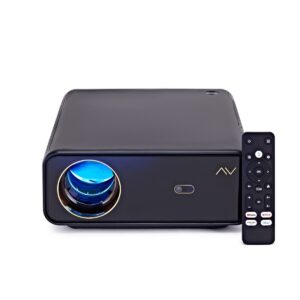
4. AVCOM FHDP160 FHD 1080p Smart Projector
 Key features
- Android TV Smart features built in
- Auto-focus and auto keystone technology
- 4K enhancing technology
Pros
- Compact design
- Easy to set up
- Can connect Bluetooth speakers
Cons
- Not enough lumens for a 300” screen
The AVCOM FHDP 160 FHD 1080p Smart Projector is a compact, usable projector that certainly defines what a portable projector ought to be. With HDMI connectivity and Android TV 12 built in, it can wirelessly stream content from popular platforms via Wi-Fi or a wired connection.
It includes smart features to reduce trapezoidal distortion, restoring the image to a proper 16:9 format. There’s also onboard software that simulates 4K, enhancing sharpness despite its native Full HD resolution.
For its size, the 1,200 ANSI lumens output is impressive and provides solid brightness for a 100-inch diagonal screen.
Bluetooth support allows you to wirelessly connect headphones or active speakers, boosting its flexibility. Its compact form also means it can be easily stored away when not in use.
The LED light engine eliminates the maintenance associated with UHP lamp replacements and allows for safe movement even when the unit is still warm.
At this price point, there’s little to fault; it delivers a straightforward, no-fuss experience that any quality portable projector should offer.
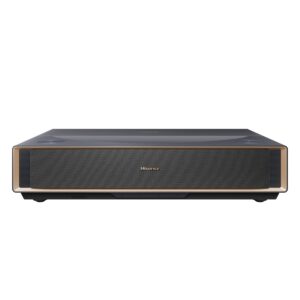
5. Hisense PT1 4K Smart Laser Cinema Projector
 Key features
- Supports 4k HDR10+
- Bolby Atmos sound system
- Wide gamut colour range
Pros
- Outstanding picture quality thanks to the Tri-Chroma RGB laser technology
- Immersive sound which exceeds expectations
- Supports 3D films
Cons
- Poor brightness with the largest recommended screen sizing
The Hisense PT1 4k Smart Laser Cinema Projector has earned critical praise and a dedicated following, thanks in part to its IMAX certification – like the C2TUK – which underscores its ability to bring Hollywood blockbusters to life.
Leveraging artificial intelligence to enhance its rich and vivid image reproduction, the PT1, like other DLP projectors in this lineup, achieves 110% of the BT.2020 colour standard and supports HDR10+ for highly realistic 4K playback. Its built-in sound system also supports Dolby Atmos, ensuring that even in a standard room setup, users won’t feel they’re compromising on audio performance.
With a peak brightness of 2,500 lumens and a realistic contrast ratio of 3000:1 (avoiding exaggerated claims like 1,000,000:1 or ‘infinite’), it’s more than capable of filling a 150-inch, 1.78:1 screen. Like others on this list, it uses 4K pixel-shifting technology to convert its 2.07 million native pixels into a true 4K viewing experience, enabling full use of the built-in streaming apps.
If you want to use it as a music system, it offers support for Apple AirPlay 2, along with wide format compatibility for music, video, and images, making it one of the most well-rounded options in this eclectic lineup.
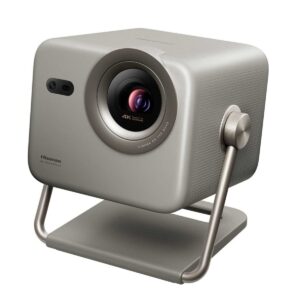
6. Hisense M2 TUK Pro 4K Projector
 Key features
- Tir-Colour laser
- Optical zoom
- 4K AI technology
Pros
- Great smart features thanks to the latest VIDAA software
- Connectivity
- Impressive picture quality
Cons
- 4K gaming limited to 120Hz
The Hisense M2 TUK Pro 4K Projector takes everything people appreciate about the larger C2TUK series and delivers it in a more compact, lightweight, and manageable form.
It retains many of the standout features that define the Hisense projector line, while introducing the newer VIDAA U9 user interface, which adds refinements like Dolby Vision support.
Just like its larger siblings, the M2 TUK Pro delivers a full 4K Ultra HD experience, projecting 3840×2160 pixels when streaming content or using a compatible source via HDMI 2.1 (eARC). Connecting a modern PlayStation or Xbox console also activates ALLM (Auto Low Latency Mode) for smoother, lag-free gaming.
Streaming is straightforward; just connect it to a Wi-Fi hub. If you have a modern smartphone, a 5G signal, unlimited data, and power, you can stream films, TV, and music from virtually anywhere, enjoying crisp visuals and immersive sound thanks to the built-in DTS Virtual:X audio system.
Its optical throw ratio enables a 100-inch image from just 3.3 metres away, with a maximum image size of 150 inches, giving you flexibility to supersize your viewing, whatever your room size. With a respectable brightness rating of 1,000 lumens, it strikes a solid balance between performance and portability.
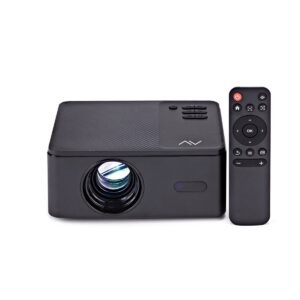
7. AVCOM HDP30 HD Projector
 Key features
- Supports 1080p playback
- Wireless screen mirroring
- Auto Keystone correction
Pros
- Budget price point
- Compact design
- Better than expected performance levels
Cons
- No backlighting on the remote
The AVCOM HDP30 HD Projector is one of the most cost-effective ways into the portable projector market. And yes, if you want audio, you’ll need to connect a pair of active speakers or even a 2.1 PC speaker setup. If you’ve got a compact 5.1 system with HDMI out, that’ll work perfectly too.
So, what does the HDP30 offer? It’s ideal for lively settings, from karaoke nights and watching the big game (up to 150 inches) to gaming sessions with friends. It’ll happily play films and TV via the HDMI input or through screen mirroring from your smartphone. And once you’re done, it can be neatly packed away in a cupboard.
It’s never going to compete with the Optoma, Epson, or Hisense models in this lineup – nor should it. It’s affordable, cheerful, and refreshingly honest. With both wireless and wired connectivity, Bluetooth support, HD Ready certification, and the ability to play Full HD content, it’s hard not to appreciate what the HDP30 offers.
How to choose the best portable projector for you
Essential features (often forgotten):
-
Wireless connectivity for streaming content.
-
A built-in smart hub with screen mirroring or integrated apps.
-
A simple audio output, such as a 3.5mm jack, for external speakers.
Convenience features (usually add to cost):
-
Optical zoom with keystone correction.
-
Built-in speakers that support home cinema audio formats.
-
Battery power and lightweight design for true portability.
Core display requirements:
-
Resolution — HD Ready, Full HD, or 4K Ultra HD (UHD).
-
A modern light source such as LED or Laser for easy setup and low maintenance.
-
Display technology — typically DLP or LCD, each with its strengths.
And finally: Budget.
When searching for the right portable projector, several of the criteria listed above will come into play. Some features will matter more to you than others, but knowing what you need from the outset will help simplify your decision.
One commonly overlooked area is the first group of features – particularly wireless connectivity. Without it, you won’t be able to stream from services or mirror content from your smartphone. While hardwired options like HDMI exist, they’re less convenient. Using a laptop can introduce issues – not all services play nicely over HDMI, and it adds extra bulk to carry.
Optical zoom lenses, while useful, are also one of the most expensive parts of a projector. They require high levels of precision, especially at 4K Ultra HD resolutions. Internal speakers, on the other hand, are always welcome, as they reduce the amount of extra gear you need.
Resolution and brightness (lumens) are two of the most important factors when it comes to real-world use. If you’re planning to watch the World Cup in the garden, a higher resolution will give you a sharper, larger image. Pair that with a strong ANSI lumens rating, and you’ll get a bright, clear picture even in less-than-ideal lighting conditions.
What does each brand offer?
Epson and Optoma are renowned globally as market leaders in projection, while Hisense is establishing itself as a strong contender – particularly in the Ultra Short Throw category – thanks to its pioneering technology. AVCOM, a newcomer to the market, is well positioned at the budget end.
Hisense is the only brand in this lineup to offer native 4K Ultra HD resolution, making it the premium choice. It uses DLP pixel-shifting technology to achieve this, whereas the rest of the models are certified Full HD or HD Ready. Both Epson and Optoma support playback of 4K film and TV content, despite having native Full HD resolution. The AVCOM projectors come in both Full HD and HD Ready versions.
When it comes to display technology, AVCOM and Epson both use LCD, but with key differences. Epson uses 3LCD technology, which eliminates flicker and provides smooth colour reproduction. AVCOM uses a single-chip LCD system combined with an LED light engine.
Hisense and Optoma, meanwhile, use single-chip DLP systems featuring DMD chipsets – each containing over 2 million tiny moving mirrors. This more costly technology bounces RGB laser light off the DMD chip to create the full colour spectrum seen on screen.
These technology choices reflect each brand’s position: AVCOM offers a budget-friendly option, Optoma and Epson bring distinctive and well-established alternatives, and Hisense sits firmly at the premium end with its true 4K Ultra HD capabilities.
Lamp vs. laser projectors
It’s taken some time for laser light engines to gain dominance in the projector market, partly due to EU legislation, but it’s a change that’s long overdue. Laser projection offers several clear advantages over traditional mercury-based UHP (Ultra High Pressure) lamp technology.
First, there’s no longer any concern about powering the projector on and off quickly. With laser, instant on/off is standard. In contrast, doing this with a UHP lamp could significantly shorten its lifespan – or worse, cause it to fail entirely.
Laser light engines have also brought unexpected improvements in colour uniformity, enabling more consistent and accurate colour reproduction across the full spectrum, something UHP lamps could never quite match.
In terms of lifespan, laser projectors now rival large TVs, offering over 20,000 hours of use – or roughly 10 years – before any noticeable dimming. UHP lamps, by comparison, typically last between 1,000 and 2,000 hours and often require costly replacements.
While the initial cost of a laser projector is higher, it’s more economical in the long run. UHP lamps rely on minerals that are heavily restricted in many parts of the world, which inflates manufacturing costs. And while cheaper replacements exist, certified UHP lamps for compatible projectors usually cost between £150 and £750.
Brightness and resolution
Brightness and resolution might seem like unrelated aspects of projection, but once you factor in screen size, they become closely linked – and often influence one another more than people realise.
Brightness plays a key role in perceived sharpness. If a projector is too bright for the environment or screen size, it can actually degrade image quality. Excessive brightness can cause blooming, where light spills over pixel boundaries, softening the image and masking fine details. This not only affects clarity but can also compromise colour accuracy and contrast.
Brightness also has a direct impact on contrast. Look for projectors rated with ANSI lumens, a real-world measurement that considers both pure white and deep black levels displayed on screen simultaneously, giving a more accurate sense of how the projector performs in practice.
Resolution refers to the number of pixels on the display chipset – whether light passes through it (as with LCD, SXRD, or D-ILA) or is reflected off it (as with DLP). For home cinema projectors, resolutions are typically measured using a 1.78:1 aspect ratio.
For example:
-
1280x720p (HD Ready) delivers just under 1 megapixel.
-
4096x2160p (4K UHD, 1.90:1 aspect) has over 8.8 megapixels.
-
7680x4320p (8K, 1.78:1) reaches a massive 33.18 megapixels.
The challenge is that projection chipsets – particularly for 4K – are physically small, often between 0.47 and 0.74 inches square. As a result, excess brightness can cause blooming that hides the benefits of high pixel density, reducing the sharpness advantage that higher resolutions should provide.
So, while brightness and resolution may appear to be separate concerns, they are in fact closely intertwined, especially in projection.
FAQs
Which portable projector offers the best brightness?
The Hisense C2TUK offers the best brightness on this list. It boasts 3000 ANSI lumens, which is about as bright as you can get from today’s laser technology.
Do portable projectors handle 4K?
Not all portable projectors can handle 4K, but in this lineup, Hisense are certainly a master at delivering 4K quality while also supporting HDR10+ standards.
Which portable projector offers the best battery life?
With only one in our list with a battery, we’d have to say the Optoma Photon Go has the longest battery life. As projectors use a lot of energy to light up a large screen, 90 minutes is as much as you’ll get from a full charge, which explains why they’re so rare.
Final thoughts
I do love projectors, but my area of expertise is with the larger machines, so it’s been so interesting evaluating these best portable projectors. Some have felt a little like they’re old technology with a renewed light engine, which isn’t a bad thing, while others have pushed the boundaries of what I thought was possible at a price point.
If you have any others you feel should’ve made it out list, why not let us know in the comments below?





0 Comments