


Are all budget speakers equal? Many think so, but actually, like with any hi-fi product, some have higher quality components, clearer sound, and just better overall design than others.
In this guide, we’ve rounded up the best budget hi-fi speakers on offer. We’ve included passive and hybrid options from brands you’ve heard of, as well as smaller, lesser-known names that excel in the affordability range.
In a hurry?
Here are our top three budget hi-fi speakers.
| Wharfedale Diamond 9.1 Bookshelf Speakers | One of my favourite budget speakers; very few speakers achieve this kind of status. | Check the current price |
| Bowers & Wilkins 607 S3 Bookshelf Speakers | I never thought the time would come when an entry-level B&W speaker could really replicate the brand's signature sound. | Check the current price |
| AVCOM 6" Bookshelf Speakers | A no-fuss speaker with smooth, clear, well-balanced sound. | Check the current price |
Why we’ve chosen these hi-fi speakers
With such a vast choice of speakers in the budget range, it can be hard to identify what makes one special. For our list, we’ve chosen award winners and speakers that are consistently championed by users. Let’s face it, who better to listen to than other like-minded users who already own these speakers and rave about them first-hand?
We’ve also looked at their build quality and, of course, musicality. Being “good enough” wasn’t enough of a justification to make it to the list; we wanted to make sure each of these speakers truly stands out.
The best budget hi-fi speakers
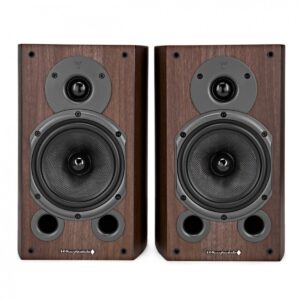
1. Wharfedale Diamond 9.1 Bookshelf Speakers
 Key features
- Multi-award-winning bookshelf speaker
- Curved, braced cabinets
- Dual reflex ports
Pros
- Years of experience and expertise behind them
- Musicality belies their price point
- Wharfedale have used a Kevlar driver even at this price
Cons
- The vinyl finish is our only gripe, but at this price point, we’re nitpicking
This is the second time I’ve recommended the Wharfedale Diamond 9.1 bookshelf speaker this year, but when there are products like the Wharfedale on offer at its price point, it’s no wonder the competition for the best budget speaker is so fierce.
Yet this speaker is, without doubt, one of the champions in our opinion for this category. It’s designed with all the know-how that Wharfedale have been built on since the brand’s conception by Gilbert Briggs from Ilkley, Yorkshire in 1932.
The speaker uses that distinctive, tightly woven Kevlar woofer, designed to fit the cabinet and its internal volume precisely, maximising its full potential with real science behind its otherwise conventional appearance.
Partner that with the 25mm tweeter, and you have a speaker that has the ability to take on its more expensive counterparts. This is one of those moments where the brand has just nailed everything perfectly. It takes a rather special bookshelf speaker to better what the 9.1s deliver.
It’s not all roses, though. Their sensitivity — 86dB into 6 ohms — means you’ll need good quality electronics to reach those lower 50Hz figures.
The higher frequencies also roll off at 24kHz, which isn’t the magic 20kHz, but you’d be hard pressed to even notice that. However, it does also give the Wharfedale there distinctive musical sound, which is rich and engaging, and I suspect this was done for the purposes of tuning to ensure this speaker still recreates that infamous brand signature.
The Diamond 9.1 absolutely meets that brief, and then some. A standout budget bookshelf speaker that continues to impress.
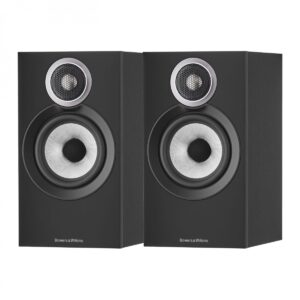
2. Bowers & Wilkins 607 S3 Bookshelf Speakers
 Key features
- New Titanium Dome tweeter design
- Five-inch Continuum cone bass/midrange driver
- Vented-box system with Flowport
Pros
- They have that classic Bowers & Wilkins sound
- Aesthetically pleasing design which will fit any decor
- Sonically, for the money, you will struggle to better
Cons
- You’ll need to use them for about 10 hours before the sound comes alive
The Bowers & Wilkins 607 S3 bookshelf speakers are, without a doubt, one of the best speakers in this line-up of distinguished speakers.
Bowers & Wilkins have at last been able to replicate that iconic signature sound without customers having to break the bank to afford one. A true first for them, and it shows trickle-down technology really works, in the end.
So, what makes these speakers so special? Well, if you’ve owned B&W speakers before, you’ll notice the yellow Kevlar driver design has gone; in its place is a new type of bass/mid-range Continuum cone woofer.
B&W have partnered the 130mm woofer driver with a titanium decouple double-dome 25mm tweeter, and together, along with their wizardry in the crossover area, they have nailed that signature sound at a price point we never thought was possible with the 600 bookshelf series.
The speakers also allow you to squeeze every last ounce of musical detail via the HF and LF terminations, which you should take advantage of if you really want to bring the very best out of the 607 S3.
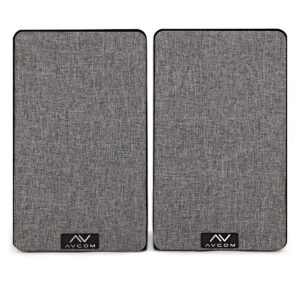
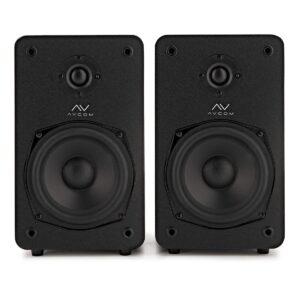
3. AVCOM 6″ Bookshelf Speakers
 Key features
- 6” Woven Kevlar bass/mid-range driver
- 1” silk tweeter harmonises high frequencies
- Magnetic grills
Pros
- Smooth, balanced sound
- Solid performance from such an affordable bookshelf speaker
- Suits a wide range of amplification
Cons
- Cabinet depth limits bass reproduction
The AVCOM 6” bookshelf speakers take a no-nonsense approach.
They feature a 6-inch tightly woven Kevlar bass/midrange woofer paired with a 25mm silk dome tweeter, a tried-and-tested combination used by some of the most prestigious brands. However, seeing this kind of specification at such a modest price point is rare.
The crossover has been tuned for accuracy. While the speaker doesn’t reach the ultra-low frequencies that some larger or more specialised designs can achieve, a claimed low end of 65Hz is still respectable for a bookshelf speaker of this size.
At the other end of the spectrum, the speaker comfortably hits the 20kHz high-frequency mark, delivering a smooth, well-balanced sound that’s free from harshness or shrillness — and far more refined than its price tag would suggest.
Build quality is another standout feature. While this is undoubtedly a budget speaker, it doesn’t feel like one. The cabinets aren’t as heavy as those found in models costing three times as much, but at this level, they easily outclass much of the competition.
Physically, the speakers have a slim profile with a bit of height, measuring 302mm tall, 181mm wide, and 164mm deep. Around the back, the speaker terminals are surprisingly high quality for this price range, accommodating both 4mm banana plugs and screw-tight bare wire connections.
Other thoughtful touches include magnetic grilles that snap firmly into place, a feature usually reserved for more premium models.
 Key features
 Key features
 Key features
 Key features
Honourable mention
Audio Pro A28 Active Wireless Bookshelf Speakers
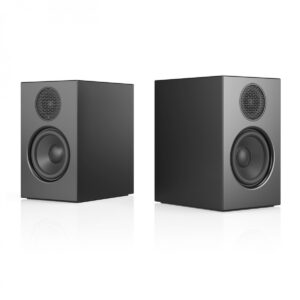 As an honourable mention, I couldn’t leave out the Audio Pro A28 wireless bookshelf speakers. They’ve earned praise from both users and reviewers.
These speakers are smaller than most people realise, standing just 238mm tall. They’re also hybrid active speakers and, unlike most, the left-hand speaker handles connectivity, with the two units linked via a run of speaker cable.
Like other hybrid active models, they come with a wealth of inputs, including HDMI ARC, Optical Toslink, and line-in, along with both Bluetooth and Wi-Fi streaming. A powerful 2x75W Class-D amplifier drives each 114mm bass/midrange driver and 25mm tweeter, setting the A28 apart from others in its class.
For those seeking more bass depth, adding an active subwoofer is straightforward, thanks to the dedicated RCA subwoofer output, further enhancing their versatility. This makes them ideal for anyone looking to build a simple hi-fi setup without cluttering the room with multiple boxes.
With HDMI ARC connectivity included, they can also double as a TV upgrade, eliminating the need for a soundbar or full AV surround system.
Very few products genuinely excite me, but these speakers have always stood out. They were the first of their kind I experienced that truly delivered on their promises.
Budget vs. premium hi-fi speakers
There are a number of things that usually distinguish premium from budget hi-fi speakers, and one of the most obvious is the complexity of the driver. Some brands use dual concentric or UniQ driver solutions, while others use clever baffle systems, which allow both the tweeter and drivers to perfectly align on the baffle, something rarely achievable at the budget end of the market.
The crossover systems in these speakers are often remarkably complex, using higher-order designs to precisely control each driver. This ensures timing is both accurate and sharply defined, without compromising the integrity of the signal.
Add to that the internal wiring, bracing structures, damping materials, and the use of high-quality components throughout, and these are the kinds of details that set premium speakers apart from typical budget offerings.
Cabinet design plays a major role as well. Many are engineered specifically to eliminate resonances and reduce unwanted distortions or interference that can affect driver performance. In some cases, a single enclosure may house multiple internal chambers, each tailored to control different parts of the frequency range. All of this adds to the overall cost.
That’s why trickle-down technology and end-of-line opportunities are so valuable; without them, many of the speakers on this list simply wouldn’t exist at this price point.
It’s this careful balance of cost and clever engineering that allows certain budget speakers to punch well above their weight.
How to choose the best budget hi-fi speaker for you
First, set yourself a budget and stick to it. This will help you narrow down your choices, limiting what speakers are available and ultimately making your goal easier to achieve. You should also know your room size and layout, as well as the seating arrangement.
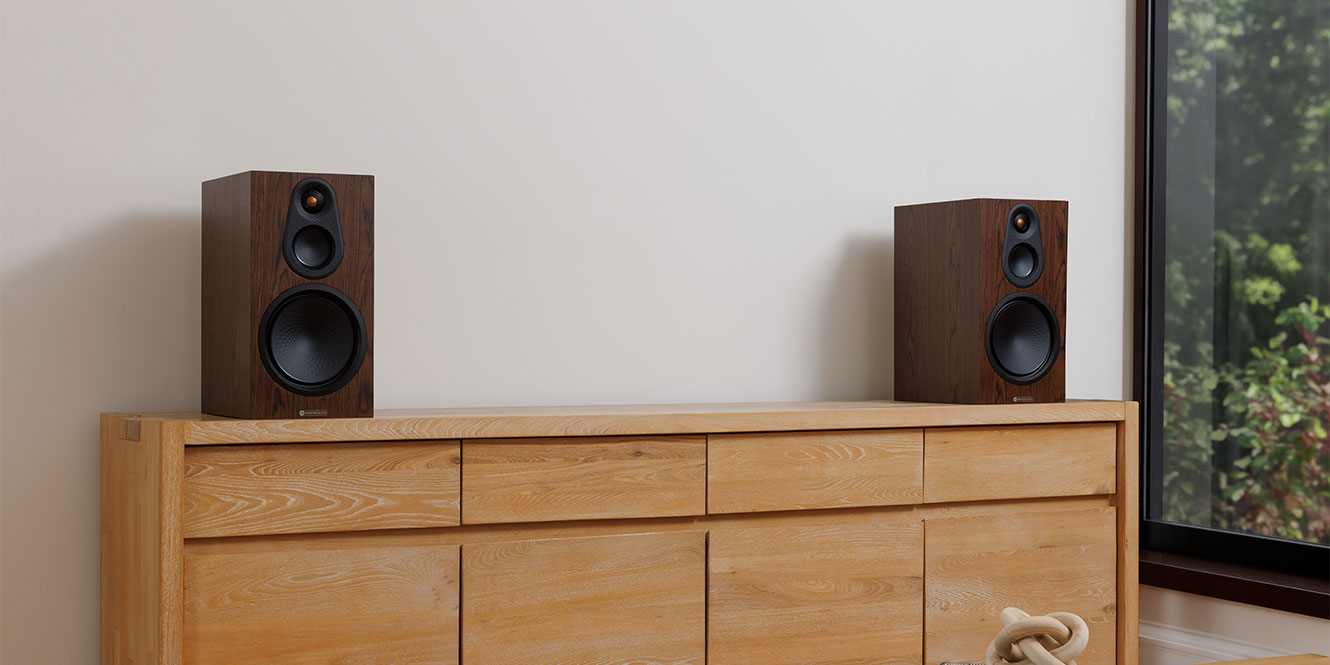
With bookshelf speakers, rear ports can be a hindrance if you plan to place them directly on a shelf, as many are designed with the assumption they’ll be used on dedicated speaker stands. If you’re positioning them close to a wall or within a cabinet, front-ported designs are a better choice; they’re far more forgiving in tighter spaces.
FAQs
What’s the best budget speaker?
If you have £500 or less to spend on a speaker, any of the options on the list above are a great place to start.
What is the 83% rule for speakers?
The 83% rule is a guideline that states that the distance between your listening position and your speakers should be 83% of the distance between the two speakers. This creates an almost-equilateral triangle, essentially the sweet spot of listening positions.
What are the best speaker brands?
When it comes to hi-fi speakers, brands like Wharfedale, Bowers and Wilkins, and Q Acoustics are known to be some of the best. They combine cutting-edge technologies with elegant designs, catering to many different preferences and budgets.
Final thoughts
I have to say, I’ve genuinely enjoyed spending time with each of these speakers, and I’m always impressed by just how good the best budget hi-fi speakers can sound. Of course, there are always going to be compromises at this price point, but once you accept that, it’s easy to live with any of these options.
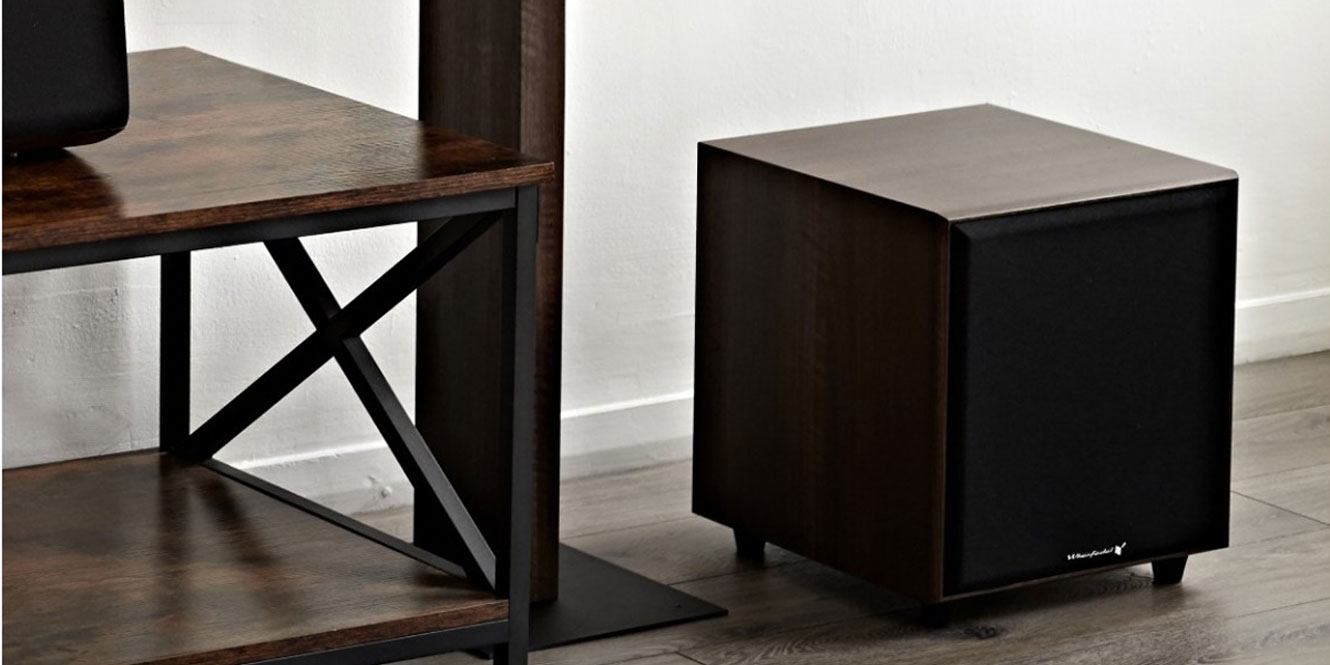
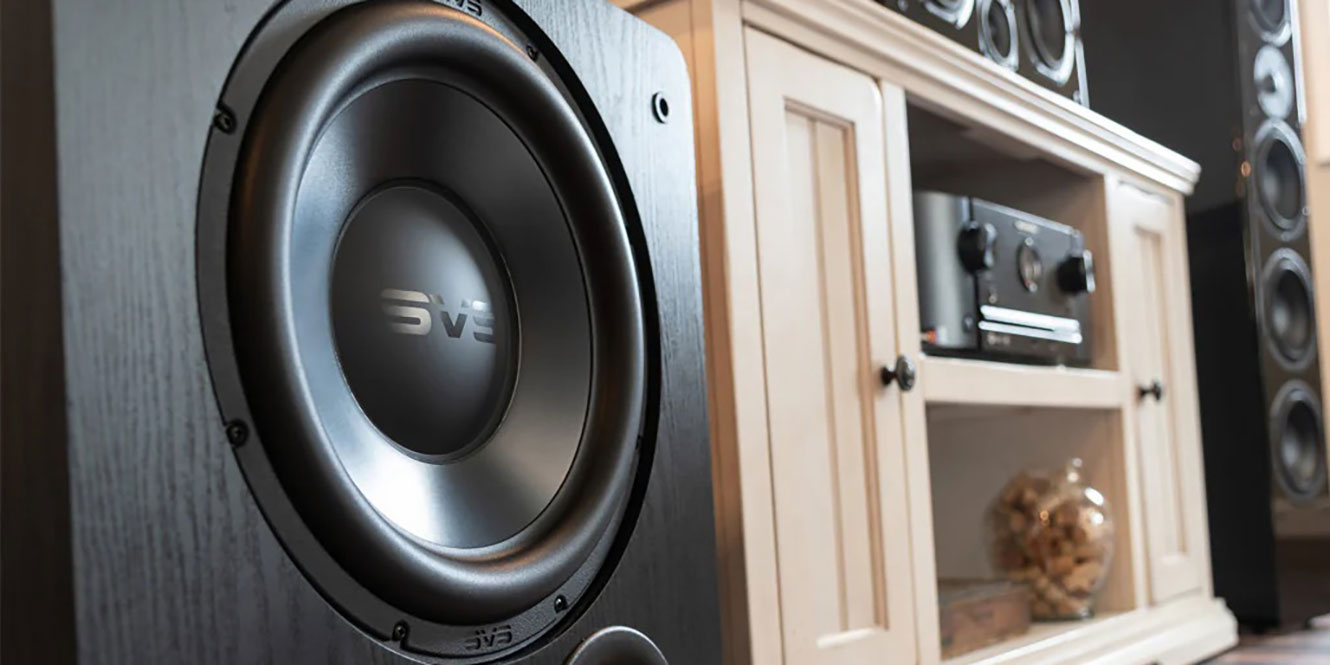
And for those who crave more bass, adding an active subwoofer to create a 2.1 system can elevate the experience significantly, often resulting in a setup that sounds far better than the sum of its parts.




0 Comments