
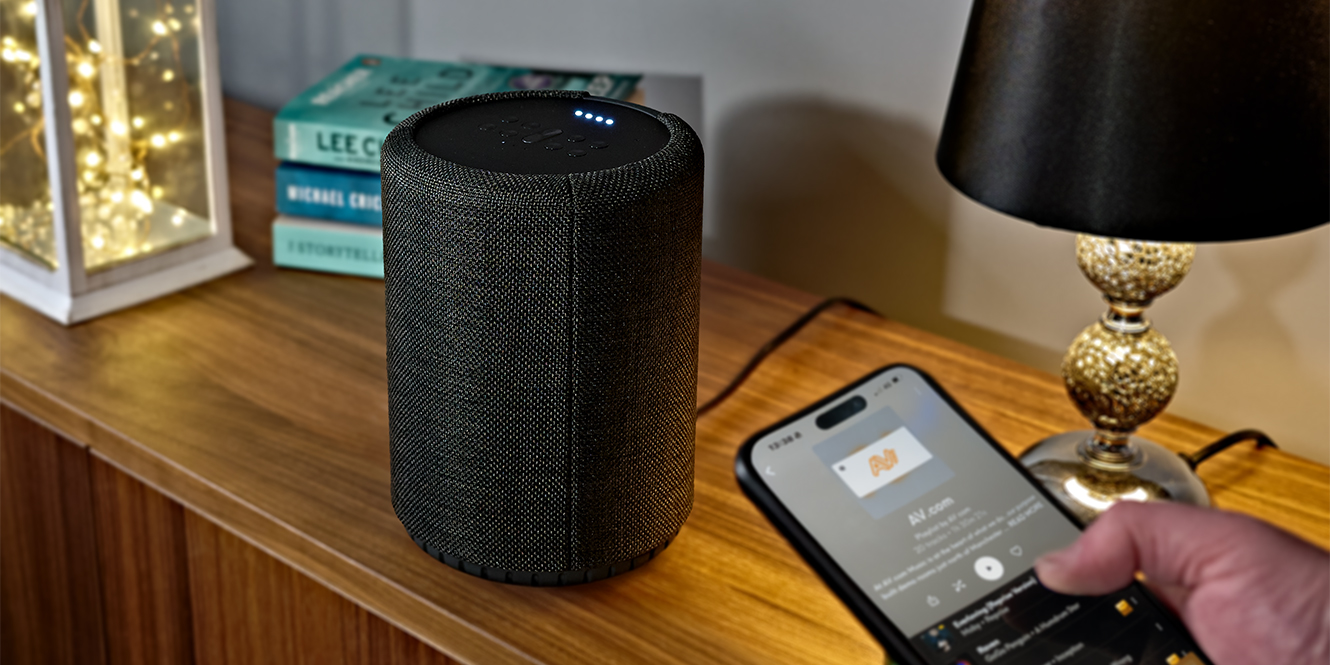

Audio Pro are one of those brands that aren’t too well known, which is criminal given that they’re competing in what, in all honesty, is an oversaturated market of wireless smart speakers. To Audio Pro’s credit, they do branch out to more typical active speaker solutions, such as their A28 and A38 speaker sets. However, the main focus of this article (if the title didn’t give it away) is the G10 wireless speaker.
The speaker has strong competition but brings its own distinct flavour and a certain “je ne sais quoi” that not many other brands manage to capture. I’ve tested the speaker thoroughly, looking at its design, ease-of-use, and, of course, its all-important sound quality and performance – and I’ve jotted everything down in this Audio Pro G10 review.
In a hurry? Here’s our verdict
To put it simply, the Audio Pro G10 speaker is pretty cool.
The sound quality from something this compact and sleek is never going to be the deepest or most immersive, but that’s not the point. It’s a home audio solution for casual use, packed with a load of other features that make it ultimately more than just a wireless speaker.
You can connect your Google Home account and integrate it into your home automation or use it as a “fancy Alexa”. The good thing is that its smart integration isn’t locked into any proprietary software or ecosystem. And it sounds pretty good. It’s crisp, clear, and detailed. If you’re in the market for something like this, i.e., a flexible, software-based smart speaker with solid sound quality, I wouldn’t shy away from the G10.
| Pros | Cons |
|---|---|
| Very easy to live | The buttons' iconography is quite hard to read |
| Balanced sound given its limitations, but sonically flexible | Bass response isn't the best |
| Aesthetically, it's very pleasing | |
| Multi-room functionality is seamless and easy to set up | |
| Flexible user experience |
Audio Pro G10 review
Initial thoughts
 It’s worth bearing in mind that in online listings, there is no “banana for scale,” but the G10 ultimately came out a little smaller than I imagined. This isn’t a bad thing; it means it’s more flexible placement-wise if you’re limited on space. The initial setup was seamless, thanks to it all being Google Home-integrated.
When it comes to assembling smart products, I use my parents as a benchmark, and, in all honesty, if they remembered their Google account passwords, they’d be able to set this up easily. To that effect, once you are set up, the default voice assistant volume is nice and deafeningly loud, which I immediately turned down in the settings.
Construction-wise, the G10 is solid. The whole thing feels very well put together, with a nice variation in textures.
The only downsides on initial inspection are the obnoxiously loud default voice assist volume and the fact that the buttons’ iconography is kind of hard to read. My eyesight is pretty good, but I was struggling with the black hieroglyphics on the slightly less black background.
Design, setup, and usability
Well, I’ve kind of touched on these already, but the overall design ethos of the G10 is very Scandinavian, which, as a Swedish company, checks out. Clean lines, simple shapes and minimalism are the objectives here, and I’m a big fan. Setting up, as mentioned, was incredibly easy, all done through Google Home, and the process took me maybe 30 seconds, and then the speaker was connected and ready to go.
If you’ve never used Google Home devices before, there are a few hoops to jump through the first time around, such as linking various media accounts, but this isn’t a major issue, provided you know your passwords.
The actual integration into Google Home is clean and straightforward, and once set up, you don’t have to use the Google Home interface if you do not want to. You can control the speaker entirely via voice commands, Spotify Connect, and similar options, and it responds exactly as you would expect. As a result, no matter which UI or UX you prefer, you are not limited in how you use it.
I had a play around with it both within apps and through the Google interface and, somewhat counterintuitively, found it least seamless to use via Google. Personally, I would set it up through Google, adjust the EQ slightly (bringing the treble down a touch and using a reductive EQ to bring out a little more bass depth), and then use it directly through your streaming app and UI of choice.
If you take the time to work out which button is which, you can also just adjust things with the controls onboard the speaker, and if it takes your fancy, you can use a voice assistant of your choice.
Features
 Wi-Fi streaming: This is basically the whole point of this product – let’s not beat around the bush. It’s designed as a compact, easy, all-in-one solution to home audio. With the increase in the use of streaming services over the last decade, or perhaps even two, it covers all bases here.
It offers high-resolution audio file compatibility with formats such as FLAC and AAC, meaning you can effectively use it as a high-resolution streaming solution.
Voice assistant: Personally, using a voice assistant isn’t my cup of tea, but I can appreciate its usefulness, and its inclusion on the speaker is welcome, even if it is not for me.
The extent of my own voice assistant usage is asking Siri to set a ten-minute timer when I have turned my alarms off and am not conscious enough to set one manually. If you are a voice assistant fan, though, this has you covered. As mentioned earlier, you can essentially use it as a “fancy Alexa” or Google Home if you wish.
Multi-room audio: Multi-room audio, on the other hand, is more my cup of tea.
Without labouring the point, Google Home allows you to connect multiple devices into a single “group”, letting you stream to several devices at the same time, with the Google service acting as a relay. In practical terms, this means you can have the same song playing from every speaker, perfectly in sync.
Why would you want this? Aside from it being cool, it means that if you’re in the living room and need to go into the kitchen, your listening isn’t interrupted. If you then head upstairs, those speakers can also stay in sync. This is particularly useful when doing jobs around the house, as you don’t need to crank the living room system just to hear it elsewhere.
It may sound gimmicky at first, but once you’ve tried it, it’s genuinely useful.
Sound quality and performance
Sound quality-wise, the G10 is very “crisp”, with a strong focus on the mid-range and top end, which isn’t a bad thing. It’s simply a design choice and a by-product of the physical limitations of the drivers inside. To achieve genuinely big bass, you either need a creative acoustic solution to work around those limitations (which is why a good fit with in-ear headphones is important) or you need a larger speaker.
The speakers in the G10 are 3”, with two 4.5” passive radiators, so given the size limitations, it’s pretty well equipped for what it’s trying to do. I do think its default tuning is a little too “toppy” for my liking, but that isn’t something that can’t be rectified.
If you go into the settings, you can access a rudimentary EQ that controls treble and bass, and by reducing the treble frequencies you can make the speaker sound much warmer and rounder, which is more my vibe.
When it comes to dialogue and voice frequencies, the G10 excels. Listening to podcasts while doing bits around the house was very pleasant, and it also suited more passive listening, such as artists like Kalaido, Atlis, or Hong-Kong-Express, with their lo-fi, easy-listening vibes.
However, when switching into a more “locked in” listening mode and leaning towards deep house, techno, or even venturing into the classic Meshuggah catalogue, the output, while very detailed, lacked the depth those genres need to really pull you in.
Listening to Juliana Barwick’s Healing Is a Miracle was an excellent experience on the G10. As the album is predominantly built around vocal layering and harmonies, everything carried through easily and effortlessly. For music that ultimately becomes quite complex sonically, the G10 kept up well.
Overall, and speaking objectively, the G10 sounds great within the space it operates in. It competes with the likes of Denon Home and Sonos products.
Audio Pro G10 speaker specifications
| Dimensions | |
| Product height | 193 mm |
| Product diameter | 140 mm |
| Product weight | 1.5 kg |
| Components | |
| Amplifier | Digital Class D, 52W |
| Tweeter | 1 x 1,25” BMR driver |
| Woofer | 1 x 3”, long throw |
| Passive radiators | Dual 2 x 4.5” |
| Inputs | |
| WiFi 2,4 GHz | Yes |
| AUX 3,5 mm | Yes |
| Bluetooth | Yes |
| Frequency | |
| Frequency range | 55-20000 Hz |
| Sound Support | |
| MP3 | Yes |
| WMA | Yes |
| AAC | Yes |
| FLAC | Yes |
| Apple lossless | Yes |
| Power Information | |
| Power consumption WiFi | 1.90 W |
| Multi-room compatibility | |
| Multi-room Airplay 2 | Yes |
| Multi-room Google Cast | Yes |
| Multi-room Audio Pro | No |
FAQs
Is Audio Pro better than Sonos?
Audio Pro is better than Sonos if warmer audio and competitive pricing are important to you. On the other hand, Sonos trumps Audio Pro in their ecosystem breadth and smart features.
What country is Audio Pro from?
Audio Pro is from Sweden and is rooted in Scandinavian audio engineering. Founded in the late 1970s, the brand emphasises clean design, balanced sound, and practical home use. Swedish design heritage drives its focus on simplicity and acoustic performance.
Are Audio Pro speakers good?
Audio Pro speakers are good for users who want strong sound quality in compact, stylish designs. They’re known for punchy bass, clear mids, and solid build quality across multiple price ranges. Many models suit music-focused listening over complex smart ecosystems.
Final thoughts
To be honest, I’m a big fan of Audio Pro as a company. I appreciate that they’re less well known than some of the other big players in this niche, and I respect how unwavering they’ve been in their commitment to what they want to do.
They don’t chase hypes or trends, and they don’t push you into a fixed ecosystem.
Everything feels very open, and as though it’s been designed with empathy rather than anything else. Sonically, their products share the same sense of crispness and detail, which is also customisable.
This not only helps their speakers sound distinct, but also allows people to listen how they want, rather than being shoehorned into a single sonic footprint. As a result, I have a lot of time for Audio Pro. The G10, as a standalone product, is exactly what you’d expect it to be and doesn’t have any unwelcome tricks up its sleeve. It feels honest, which is always good to see.
To end our Audio Pro G10 review on a slightly daft analogy, the G10 is tomato soup. Is it the most exciting soup? No, but a good tomato soup is always exceptionally welcome, and the G10 is a good soup.






0 Comments