
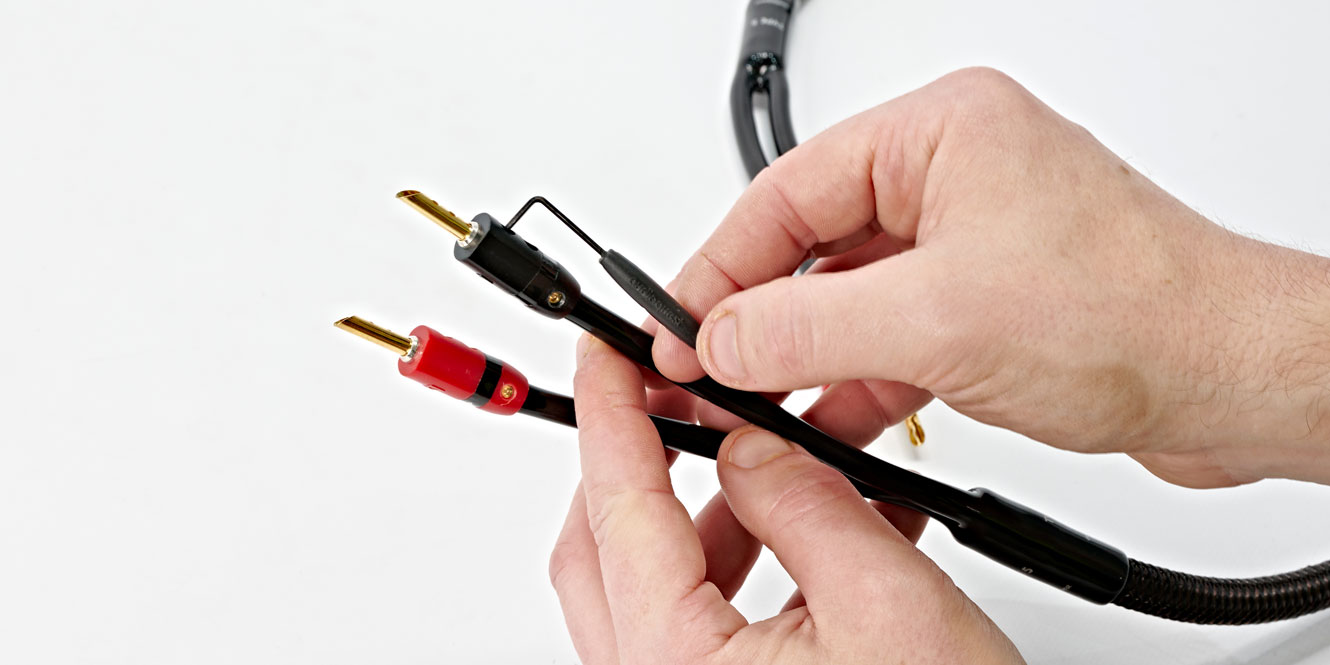

You may own or have just bought yourself a brand new hi-fi/cinema system and want to maximise its full potential by upgrading your speaker cables. But there are so many out there, which are right for you and your setup? The best speaker cables are ones that create the most revealing, accurate sound possible, and in this article, we’ll run through our top picks to help you narrow down your search.
Whether you buy QED, AudioQuest, or Chord speaker cables will depend on your system and how much you’re willing to spend. One thing is for sure, though, if you own a pair of passive speakers, you’re going to have to choose some speaker cable that fits with their character and your hi-fi system.
In a hurry?
| Chord EpicX Speaker Cable | Perfect for established hi-fi systems where you need more "openness" in your sound. | Check the current price |
| AudioQuest Rocket 22 Black PVC Speaker Cable | A dependable speaker cable, perfect for any hi-fi system. | Check the current price |
| Fisual S-Flex Studio Grade White Speaker Cable | Quality doesn’t come cheaper than the Fisual S-Flex Studio range. | Check the current price |
Why we’ve chosen these cables
If you’re picky about cables, it might take you hours auditioning many different options to find the right one for your system.
Thankfully, you have our expertise to speed up this. We have played the listening game for many years and have come across a good few speaker cables that we think stand up to be classified as the best.
Only the best speaker cables which have adhered to our strict criteria made it into the line-up. Our top picks all reveal musical details better than their competition, are built for longevity, and do exactly what they say on the tin: reproduce sound with clarity.
So, what’s a speaker cable’s purpose? This is simple. it’s to create the best possible audio reproduction from the amplifier or AV receiver to the speakers. A good speaker cable won’t make your speakers sound better – that’s a poor salesperson’s tactic!
The best speaker cables
1. Chord EpicX
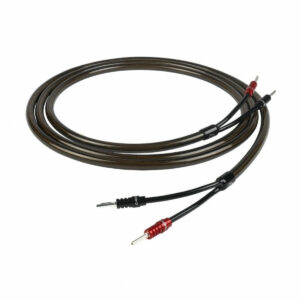 Key features
- Silver plated oxygen free copper (OFC) construction
- Twisted configuration with multilayered insulation, shielding, and cosmetic jacket design
- AWG 12 (11mm diameter)
Pros
- Revealing nature allows your speakers to breathe naturally
- Allows your speakers to create space between the musical notes
- Musical decay becomes effortless as notes ebb away
Cons
- Unsightly large compared to some of it’s competition
So, we’ve started with the most expensive cable first. Why, you might ask? Well, I own this cable and use it daily. I like a return for my pennies and the Chord EpicX certainly delivers big on this front – so I had to include it as one of the best speaker cables you can buy.
Musically, it brings the very best of what your amp can deliver to your speakers in such a way that music seems effortlessly enjoyable. You stop analysing your system and enjoy what you are hearing, which is the holy grail for hi-fi.
The way it naturally ebbs and flows with your speakers really creates a sublime soundstage. The Chord EpicX could be the last cable you ever buy!
2. AudioQuest Rocket 22
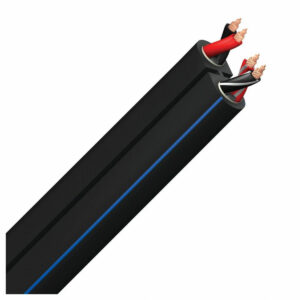 Key features
- Semi-solid conductor
- Double spiral geometry configuration
- Dual single or bi-wire configuration
Pros
- An open, well-balanced signature allows for an easy electronics partnership
- Very revealing without sounding harsh
- Fantastic at unmasked hidden detail with the right speakers
Cons
- Can show up a system’s abilities and weaknesses
As cables go, this is a middle-of-the-road in terms of looks, but hook it up to any reasonable hi-fi system and the hard work AudioQuest have put into the Rocket 22 becomes very apparent.
The price point of speaker cabling is very competitive, but like the Chord EpicX, you really get what you pay for with the Rocket 22. It brings an authoritative presence with character, allowing you to hear your speakers clearly, unlike many cables which can mask some finesse and detail.
The cable also delivers convincing higher frequencies without sounding harsh – a key reason why we’ve picked the Rocket 22 to sit within this prestigious line-up of speaker cables.
3. Fisual S-Flex Studio Grade
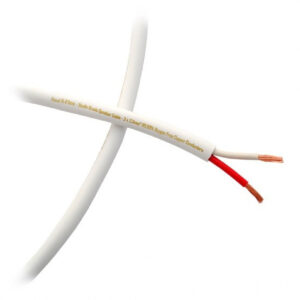 Key features
- 99.999% oxygen-free copper
- Super low loss transfer rate
- Multi-stranded conductor arrangement
Pros
- Revealing ability far above its price point
- Rich bass reproduction
- Detailed clarity and open midrange
Cons
- Soft rubbery feel to the outer jacket
Fisual might be an unknown speaker cable brand, but micro speaker brands and DIYs use the S-Flex Studio Grade cable within their speakers it’s that good! Don’t be fooled by its ridiculously low price (it’s one of the most affordable in our lineup) and mundane exterior – it really shines as one of the best speaker cables.
I compared the S-Flex with a very popular £25 per metre speaker cable and expected it to fail miserably. To my surprise, not only was it a fraction of the price, but it also put the other speaker cable to shame, almost making it sound sluggish and uninvolving.
I’ve only found a handful of cables that have achieved this. It shows that name isn’t everything. If you want performance at a budget price point, this cable can do no wrong.
4. Chord Company RumourX Speaker Cable
 Key features
- Oxygen-free copper conductors
- XLPE insulation
- 6mm diameter
Pros
- Slim and discreet
- Smooth and rhythmically adept
- Stand-out cable design
Cons
- Hard to fault, but as it adds a lively, punchy tone, it might not be for you if you prefer a more neutral sound
An excellent mid-priced cable, the Chord Company RumourX is designed to bring premium clarity and detail to most standard hi-fi systems and home cinemas. In fact, it’s a What Hi-Fi? award winner, so you know it’s going to be good.
With a slim six-millimetre diameter, it doesn’t look bulky against your setup, it looks sleek and discreet. And the way it elevates your audio is just as great, with a twisted configuration for a reduction in noise interference and silver-plated oxygen-free copper conductors that bring out all the liveliness and expression in your sound. For that extra bit of clarity, the cable also boasts XLPE insulation rather than the usual PTFE – a nice upgrade on a cable that doesn’t break the bank.
If you’re after something to make your system feel that little bit more premium, the Chord Company RumourX is the cable.
5. QED Silver Anniversary XT
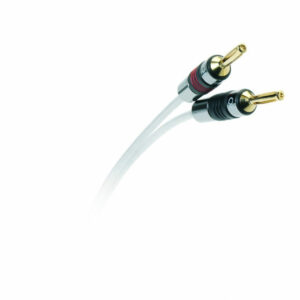 Key features
- X-Tube Technology with a polycore centre
- 99.999% Oxygen Free Copper Conductor technology
- Triple braiding 16 AWG wire
Pros
- Tried and tested cable which stands out for its ability
- Warm signature appearance without masking higher frequencies
- Musically good and tuned for a wide range of electronics
Cons
- Not as controlled as some of the higher-value cables listed here
Chances are, you either own or have heard the sound reproduction of the QED Silver Anniversary XT.
It evolved from the traditional Silver Anniversary speaker cable, after which QED stepped up and transformed the world of speaker cabling again. They created a mass market of OFC twisted silver plated speaker cables, using x-tube technology, and made it affordable. It might not be perfect in the brightest sounding systems, but it’s a revelation everywhere else
It opened everyone’s ears and made them realise that speaker cables matter.
6. QED Micro
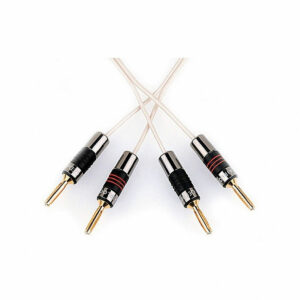 Key features
- 99.999% oxygen-free copper wire
- Discrete figure 8 cable design
- Low-density polyethylene insulation
Pros
- Perfect speaker cable companion for those who require maximum performance with minimal fuss
- Warm sound signature assists a harsh-sounding system
- Detailed midrange ability
Cons
- Missing out on the finesse and clarity of some higher-value cables
The QED Micro is a masterclass in retaining musical clarity, and it does so in such a compact form.
Its ultra-discrete exterior measures just 2.4mm x 5mm. The QED Micro speaker cable’s performance far exceeds expectations. If you need a very discreet high-performance speaker cable that won’t break the bank balance or require you to use bell wire, this is a superb option.
Whilst it’s not the most premium cable, it’s one of the best when you want your speakers to perform well but need to compromise size and space.
How to choose the best speaker cables for you
Length and number of cables
The first thing you need to consider is the length and configuration of the cables. Ideally, a hi-fi configuration should have a minimum length of around three to three and a half metres per side. This ensures optimal conductivity from the source to the speakers.
It’s recommended to use identical speaker cables because even small differences in length can negatively affect the timing of each speaker.
If your speakers and amplifier are connected using a single pair of cables, that’s straightforward.
However, things get more complicated if you have bi-wireable speakers, amplifiers with dual speaker termination outputs, or pre/integrated/power amp systems. The key here is to match HF and LF with the corresponding cables and amplifier. Mixing these up could and most likely will cause damage.
If you are running down a bi-wireable configuration, be sure to also remove the speaker spades. Then it’s a process of experimenting and trusting your ears!
Banana plugs
While banana plugs make setup easier, if you’ve invested a lot in high-quality speaker cables only to use cheap banana plugs, you may end up undermining the whole purpose. So, it’s important to keep things in perspective and use sensible, quality components.
The QED Micro cable is so cost-effective in terms of conductivity and price per metre that using banana plugs for convenience would actually cost more than the cable itself if I were to buy two three-metre lengths.
If I were to do the same with the AudioQuest Rocket 22 speaker cable, I want to ensure that I have the best connection to both the speaker and amplifier. This would mean that I would only ever use them with banana plugs.
It’s mostly about the quality of your system and whether the added cost is justified. We don’t want to compromise the overall performance of the speaker cables by adding an unnecessary component.
Compatibility with your system
As we touched on above, cables can be used as a get-out-of-jail option and enhance the sound of your system – but this isn’t really their purpose. The best speaker cable will improve the effectiveness of your hi-fi system. It won’t improve the sound quality of your speakers, rather, it will assist it. Having the right hi-fi system in place and allowing the speaker cable to reveal your speaker’s true ability is what it’s all about.
For example, if there are small whispers in a track, a good speaker cable will make that whisper, and all other tiny details, clear and audible.
If you have a harsh- or bright-sounding system, a purely copper-based cable will be the best option. If you need more of an oomph and musicality in your sound, silver or silver-plated speaker cabling is ideal.
You’ll see that some of our choices use a twisted design. This is to assist with signal path and minimise electromagnetic interferences which can degrade the signal, improving the entire frequency range.
Budget
Through my experience conducting various experiments with speaker cables, I can confidently say that our electronic systems and speakers can benefit from using any of the speaker cables that we have identified as the best.
Even sub-£100 speakers using the AudioQuest Rocket 22 will reveal an astonishing amount of musical detail. However, it’s important to remember that your sound will only be as good as your speakers.
The general rule is you should spend about 10% of your system’s entire worth on your speaker cables. If you spend more, whether you’ll hear more will depend on your hi-fi system’s ability.
Does a good-quality speaker cable make a difference?
The simple answer to this is yes! It won’t improve a poor-quality system, but it will allow your speakers to perform to their full potential.
When comparing speaker cables, the price shouldn’t affect the quality. Yes, you can spend thousands on speaker cables, but we have illustrated that spending a modest budget can still get you a good speaker cable and one that might last you a lifetime.
For conductivity, silver cables are the best while copper and tin are a little less comparable.
The general rule is that cable runs should be between 3m and 3.5m. If you own a highly sensitive system, you’ll probably notice a difference. However, if you have a less sensitive hi-fi system, which is not as affected by minor changes like these, you’ll most likely be content with the overall sound quality as long as it’s initially well-rounded.
FAQs
Do shorter cables sound better?
The rule is to use cables around the 3m to 3.5m length as these will keep sound production accurate and clear. If you have to use longer, keep the lengths identical as this will help with timing.
Do banana plugs improve the sound?
Just like speaker cables, banana plugs cannot make your speakers sound better than they already are; they can only help your speakers become more revealing. If the speaker cable is soldered onto the banana plugs, there is better conductivity. However, this will only reveal more information from your speakers, rather than improve their quality.
What is the best speaker cable thickness for my system?
Your cable thickness will ideally be between 1.5mm and 4mm wide. Longer runs of cable are usually thinner, while distances of around 3m work better with thicker cables of about 4mm.
Final thoughts
We hope you’ve found everything you need to know about cabling and spotted your perfect match on our list of the best speaker cables available!
Take a look at our full range via the link below.





0 Comments