
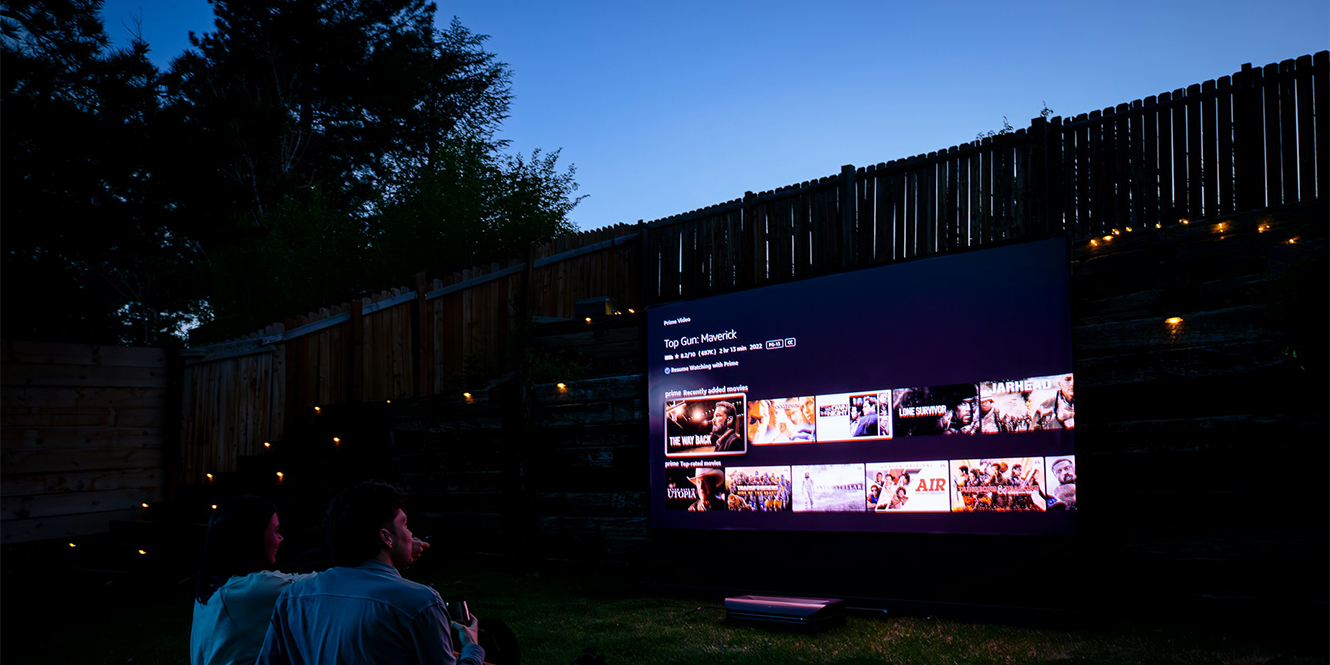

Having specced out plenty of home cinemas in my time, one question that tends to come up is, “What do we do about the sun?” As dramatic as it sounds, dealing with light is a real problem when it comes to projection. Thankfully, we have developed everything from specialised screen materials to laser light sources to help manage it.
But if you want to soak in as much Vitamin D as you can while you sit in your orangery-come-home-cinema, here are some things to watch out for to make that dream come true.
Key takeaways
Screen grain pattern: Grain pattern refers to the surface texture of a projection screen.
Screen gain: This measures how much light a screen reflects toward the viewer compared to a standard matte white surface.
Projector brightness: Measured in lumens, projector brightness indicates how much light the projector outputs. Higher brightness improves visibility in ambient light and on larger screens.
Choosing a projector setup for daytime viewing or a bright room
Before I jump into things, it’s worth noting that none of the specific points mentioned below will solve the conundrum of watching a projector in a bright room on their own; in reality, it’s a sum of all parts.
Screen grain pattern
Screen grain pattern might not be something that immediately comes to mind, but projector screens, being a fabric, have a surface grain, and that grain controls how light is reflected.
Imagine a sheet of paper divided into tiny square grids. In each grid sits a small pyramid. Light hitting those pyramids from any direction is scattered back out in every direction. That’s essentially how a standard matte white screen behaves. It diffuses light evenly, which is ideal in a dark room, but in a bright space, it becomes a problem.
Ceiling lights, lamps, and yes, the aforementioned sun, all hit the surface and bounce straight back toward the viewer, washing out contrast and turning blacks into grey soup.
An Ambient Light Rejecting (ALR) screen behaves very differently. Instead of a uniformly diffusive surface, it uses a micro-structured optical layer (try saying that ten times fast). Rather than pyramids, imagine thousands of precisely angled ridges in lenticular patterns engineered to control the direction of reflected light.
To keep the idea very simple. It only reflects light coming from the designed angle back to the viewer, and all other light gets dissipated away from the eyeline.
The result is improved perceived contrast in bright rooms. Less stray light reaches you, so blacks appear deeper and colours retain more saturation. Because nothing in this world is perfect, there are trade-offs: ALR surfaces can narrow viewing angles, and lower-quality materials may introduce visible texture or sparkle. But when matched correctly to projector placement and room layout, it works.
ALR isn’t about brute-force brightness, it’s about engineering the directionality of light.
A prime example of this type of screen would be the Sapphire 16:9 ALR Projector Screen, typically designed for use with UST projectors (we get to that later).
Screen gain
If ALR controls direction, screen gain controls intensity.
Screen gain measures how reflective a surface is compared to a neutral reference. A gain of 1.0 reflects light evenly. Above 1.0 reflects more light toward the central seating position. Below 1.0 reflects less.
At first glance, higher gain seems like the obvious solution. More reflected light should mean a brighter image that can compete with daylight. Up to a point, that is true. A gain of around 1.1 to 1.3 can help add punch and maintain image brightness when ambient light is present.
However, gain achieves this by focusing reflected light more narrowly. As gain increases, viewing angles decrease. Move too far off-axis and brightness drops. Push it further, and you may encounter “hot-spotting”, where the centre of the image appears brighter than the edges because the light is being concentrated unevenly.
For most bright living spaces, a moderate gain paired with an ALR surface is the sweet spot. Something in the 0.8 to 1.3 range is common, depending on projector brightness. Ultra-short-throw ALR screens often sit below 1.0 gain because their ambient light rejection does the heavy lifting.
It is also important to remember that gain does not create brightness. It redistributes the projector’s existing light. If the projector is underpowered, a high-gain screen will not solve the problem.
Projector brightness
Brightness is usually the first specification people look at, and one of the most misunderstood.
Projector brightness is measured in lumens that indicate how much light the projector produces. In a dark cinema room, 1500 to 2500 lumens can be more than enough. In a bright living space with windows and reflective surfaces, you’re typically looking at 3000 lumens and above to maintain impact during the day.
But brightness on paper is only part of the story.
Perceived brightness depends on contrast, colour saturation, and how well the image resists washout from ambient light. A projector with strong contrast can look punchier than a higher-lumen model struggling against reflections.
Light source plays a major role here.
Traditional lamp-based projectors use high-pressure bulbs to generate white light. They can be bright, but their output gradually dims over time, and colour stability can shift as the lamp ages.
Laser projectors operate differently. They use light produced at specific wavelengths, which allows for greater efficiency and stability. The result is brightness that feels more consistent and colours that appear more vivid. A laser projector rated at the same lumen output as a lamp model will often look more dynamic in a bright room.
Laser light sources also maintain their brightness far more consistently over thousands of hours, which matters when you are already fighting ambient light.
Even so, brightness alone will not overcome direct sunlight hitting the screen. The goal is not to overpower the sun, but to balance projector output, screen technology, and room conditions so the image remains watchable and engaging.
Ultra short throw projectors
Ultra short throw projectors deserve an honourable mention in bright-room setups. Because they sit just inches from the screen, there is far less distance for light to travel, reducing loss of intensity across the room. More of the projector’s output reaches the screen efficiently, rather than dispersing into the space before it even forms an image.
Their steep projection angle also pairs exceptionally well with dedicated UST ALR screens. These screens are engineered specifically to reflect light coming from below while rejecting overhead ambient light (you can mount them on the ceiling, but you’ll then need to mount your ALR screen upside down). The result is a focused, high-impact image that holds up impressively well in brighter environments.
A good UST projector, like the Hisense PX3 PRO, and an ALR screen are the simplest way to solve the bright room home projection issue.
FAQs
Do all projectors need a dark room?
Not all projectors need a dark room, but most perform best with controlled lighting. High-brightness models can handle ambient light, yet image contrast and colour depth improve significantly in darker spaces. Room lighting directly impacts clarity and viewing quality.
How many lumens do you need for a projector in a bright room?
A projector in a bright room typically needs at least 2,500 to 4,000 lumens for clear visibility. Higher lumen output helps overcome ambient light and maintain image brightness. Larger screens and daylight conditions may require even more brightness.
What colour projector screen is best for a bright room?
A grey projector screen is best for bright rooms because it improves contrast under ambient light. Grey screens absorb excess light and reduce washout compared to white screens. This results in deeper blacks and more balanced image performance.
Final thoughts
Well, that’s certainly a lot of information. Kudos to you if you’ve stuck around this far. As I’m sure you’ve gathered by now, being the savvy reader that you are, getting the most out of a projector setup in a bright room doesn’t come down to one easy fix. It’s about careful planning, considered options and specs, and a real understanding of the space it’s going into.
It’s quite a big topic to unpack and tackle on your own, so if you’re ever unsure, feel free to drop into the showroom, or give us a call or email, and we can offer advice and guidance to help you design something that fits your space and needs.





0 Comments