
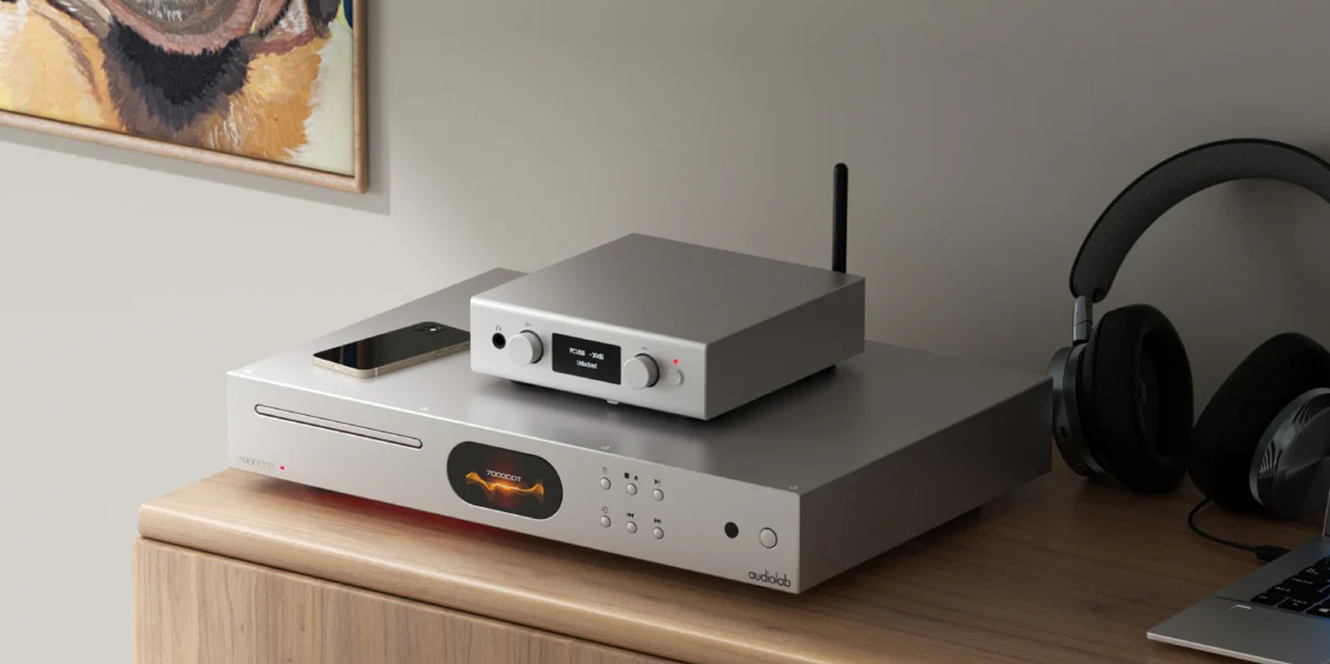

DACs are an unassuming but highly effective piece of gear to add to your system. Whether you’re using it as part of a headphone setup (read about how it can improve your headphone quality) or as part of a pre-processing stage for a full system, the whole thing can live and die on the quality of a DAC.
Now, to nip that intrusive thought in the bud, you don’t need to spend the big bucks on a DAC anymore. Back in the day, a good one would have run you in the region of a grand or so. But with the wonders of modern manufacturing, this is no longer the case. So with that in mind, here are my picks for the best DACs under £500.
In a hurry?
Here are my top three:
| Chord Electronics Mojo 2 | Compact, excellent performance, an icon of the hi-fi world. | Check the current price |
| Audiolab D7 DAC & Headphone Amplifier | Detailed sound, wide soundstage, great at driving more demanding headphones. | Check the current price |
| Astell&Kern AK HC3 | High performance, extremely portable, solid build quality. | Check the current price |
Why we’ve chosen these DACs
Put simply, the selection of DACs here is based on how much I have enjoyed listening to them, as well as what I feel they bring to a setup, be it headphones or full systems. I looked at their sound quality and how well they can play with other equipment.
Additionally, as we’re looking specifically at DACs under £500, value for money was a really important factor to keep in mind. It’s important to remember that hi-fi is a hobby that has a relatively steep curve of diminishing returns. The ones listed here balance affordability with genuinely great features and performance.
It’s also worth mentioning that hi-fi is meant to look good, and as a bonus, I’ll give out some “style points”, as it’s always nice when your gear looks good!
The best DACs under £500
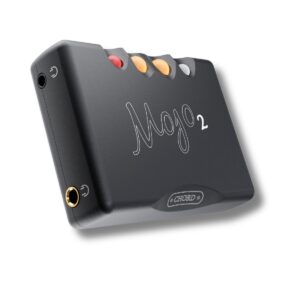
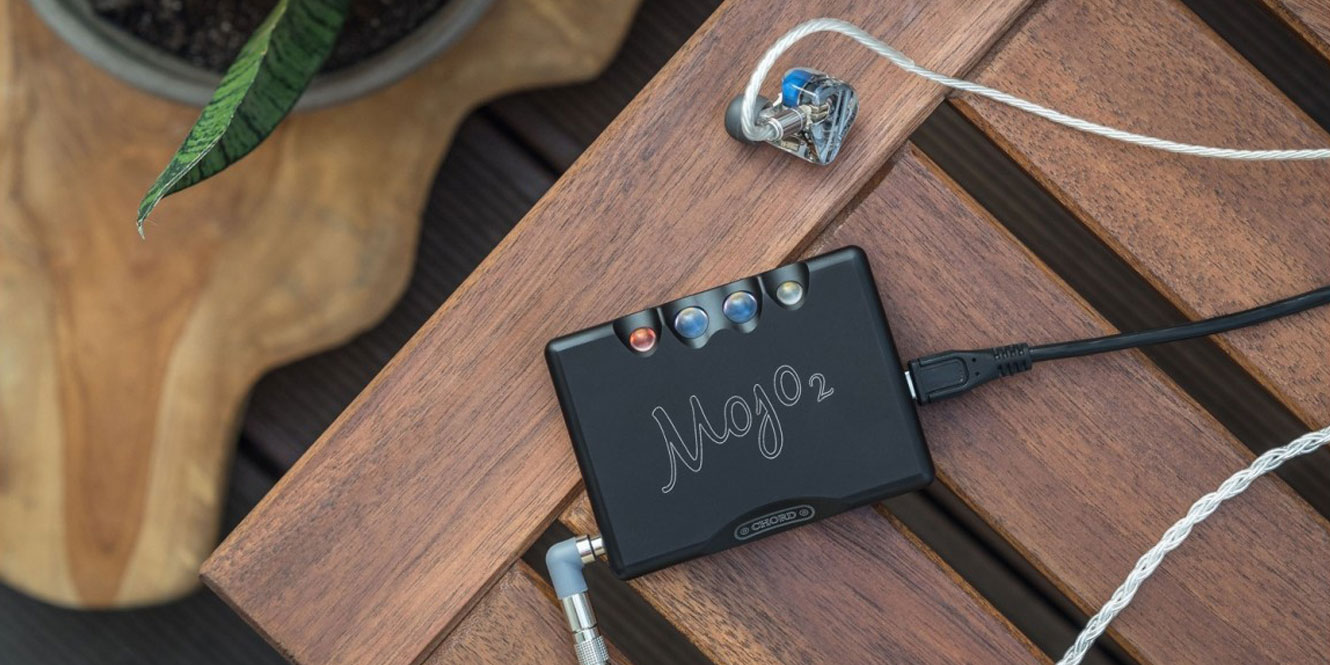
1. Chord Electronics Mojo 2
 Key features
- 2026 version features a new 4.4mm headphone jack for more connectivity options
- 40 DSP cores
- 4-band EQ
Pros
- Small and compact
- New 4.4mm connection
- New switchable USB-C input for either Data transfer or fast charging
Cons
- Chords’ insistence on using a colour-coded button system is a little frustrating and requires you to learn all the different combinations
The Mojo 2 is a certified legend in the hi-fi world. It was one of the first DACs I played around with that genuinely opened my eyes to the appeal of having something compact for a wired headphone setup on the go. As a piece of gear, it just makes sense.
Sound-wise, it performs excellently, and the addition of a 4-band EQ lets you tweak the sound profile to suit your ears. That said, I’m a strong believer in letting things sound the way they were intended rather than feeling the need to adjust it. But that’s just me.
The Mojo 2 is probably the best portable DAC solution out there. It has stood the test of time and is pretty much universally loved. The only real issue is that it’s not really designed for a larger system, so finding a way to secure it in place is a little awkward.
It performs flawlessly in a traditional system setup, as you’d expect. That said, if your rack is full of standard 19-inch units, this tiny little DAC can look slightly out of place – though perhaps there’s a kind of strange aesthetic appeal in that.
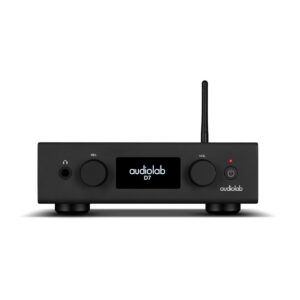
2. Audiolab D7 DAC & Headphone Amplifier
 Key features
- Full MQA decoding up to 32-bit 768kHz, DSD512
- OLED front display
- Built-in headphone amp
Pros
- Very detailed sound, courtesy of the ESS9038Q2M DAC chip
- Built-in headphone amp does a decent job driving larger and more demanding headphones
- Designed with Audiolab’s HyperStream II implementation and Time Domain Jitter Eliminator technology
Cons
- Lacks some connectivity (but that’s what the D9 is for)
The Audiolab D7 is a powerful unit in its own right, but just to get the comparisons out of the way, the D9, its bigger, more expensive brother, has all the connectivity you could want, a colour display, and a host of quality-of-life features layered on top.
What the D7 offers instead is a more stripped-back, utilitarian approach, and in many ways it feels like a more direct spiritual successor to the legendary M-DAC of yesteryear. Less flash, more function, and a very clear focus on sound quality first.
The D7 sounds excellent – there’s no real argument about that. It presents a clean, wide soundstage with plenty of dynamic control, never feeling congested or soft around the edges.
Despite its relatively compact size, the amount of connectivity packed into the rear panel is genuinely impressive. You get XLR and RCA outputs, USB-A and USB-B inputs, optical and coaxial digital inputs, and even 12V triggers, should you want to integrate it neatly into a wider system. It feels properly thought through as a serious hi-fi component rather than a lifestyle add-on.
In terms of sonic character, the D7 very much delivers on what people tend to associate with the “Audiolab sound”. It’s neutral but muscular, controlled without being sterile. It doesn’t try to impose a heavy-handed signature or artificially sweeten your music. Instead, it lets the source material come through clearly and honestly, giving downstream amplification the space to do its own thing.
There is a sense of authority to the presentation, particularly in the low end, but it never feels overcooked or forced.
This approach makes the D7 an excellent translator between digital source and analogue output, which is exactly what a great DAC should be. It’s not trying to steal the spotlight or dominate the system. It’s there to do its job properly, reliably, and with a level of refinement that belies its size and price.
If you’re looking for a DAC under £500 that prioritises sound quality, connectivity, and long-term system compatibility over flashy features, the Audiolab D7 is a very easy recommendation.
3. Astell&Kern AK HC3
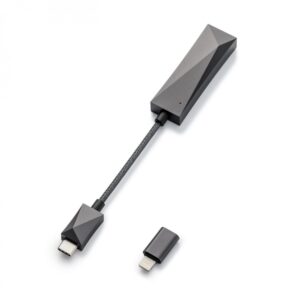 Key features
- Supports MQA 8X high-resolution playback
- USB-C and Lightning adaptor included
- Dual ESS ES9219MQ DAC for MQA playback at 32-bit/384 kHz
Pros
- Extremely portable
- Solid build quality with a reassuring weight
- Sounds fantastic for something so unassuming
Cons
- It doesn’t look like much for the money, but that’s kind of Astell&Kern’s design aesthetic
The Astell&Kern AK HC3 is one of those ultra-compact DAC and headphone amp units that feels like it was designed specifically for people who want high-end sound without being married to a rack full of gear.
Unlike full-size desktop units, the HC3 is a portable-first device that doesn’t compromise on performance. It’s the sort of thing you could keep linked to your laptop or phone for everyday listening, but also happily park next to a hi-fi setup and let it do its thing there too. The entire build feels very Astell&Kern: premium materials, reassuring weight, and a finish that doesn’t look out of place.
Sound-wise, the AK HC3 is confident without being shouty. It has a smooth, detailed presentation with a focus on refinement and clarity. There’s enough power to drive most headphones you’ll realistically use with it, and it behaves with composure from low to high volumes, giving you a sense of control rather than a sense of strain.
The tonal balance leans toward natural rather than coloured, so instruments and vocals feel unforced and real rather than artificially polished – just as the artist intended.
This is more than “just a dongle DAC”. There’s a sense of resonance and body to the sound that many compact units lack.
4. iFi ZEN Air DAC
Key features
- Burr-Brown DAC with True Native architecture
- Supports PCM, DSD, DXD, and MQA playback
- Built-in headphone amplifier with XBass+ enhancement
Pros
- Natural, balanced sound with excellent clarity
- Wide support for high-resolution audio formats
- Simple all-in-one desktop listening solution
Cons
- Limited to unbalanced RCA line outputs
The iFi ZEN Air DAC gives you a straightforward way to improve the sound from your laptop, tablet, smartphone, or games console. By handling digital-to-analogue conversion externally with iFi’s Burr-Brown chipset, it delivers greater clarity, improved instrument separation, and a more natural tonal balance than most built-in audio hardware.
Its True Native architecture keeps PCM and DSD data on separate signal paths, preserving each format in its original form right through to analogue conversion. If you listen to high-resolution music, this helps maintain the integrity of your audio without unnecessary processing along the way.
The ZEN Air DAC also supports PCM up to 32-bit/384kHz, native DSD256, DXD, and MQA playback, making it well suited to both locally stored music and compatible high-resolution streaming services. As your music library grows, it has the flexibility to handle a wide range of formats through one compact desktop unit.
Built-in headphone amplification means you can create a complete personal listening setup without extra equipment. PowerMatch provides extra gain for more demanding headphones, while XBass+ adds low-frequency weight when needed. An analogue volume control preserves audio detail as you listen, keeping the experience clean, controlled, and enjoyable.
5. FiiO K13 Compact Desktop R2R Architecture DAC and Headphone Amplifier
 Key features
- True 24-bit R2R DAC architecture
- Switchable NOS and OS playback modes
- Ten-band PEQ with balanced headphone output
Pros
- Natural, detailed, and engaging sound reproduction
- Powerful output drives demanding headphones easily
- Flexible sound customisation with built-in PEQ
Cons
- Desktop-only design limits portability
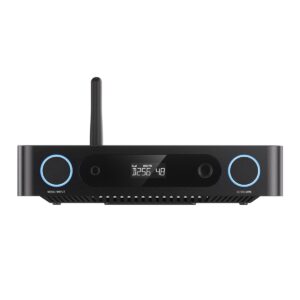
The FiiO K13 is an excellent DAC under £500 if you want detailed, natural sound alongside the flexibility to tailor your listening experience. Its true 24-bit R2R DAC architecture uses 192 precision resistors to recreate your music with a warm, lifelike character, while the fully balanced amplifier circuit helps reduce noise and preserve fine detail throughout the signal path.
You can choose between two distinct listening modes to suit your preferences. NOS mode delivers a smoother, more analogue presentation, while OS mode provides a cleaner, more detailed sound for high-resolution playback. This gives you the freedom to match the K13’s character to different albums, genres, or headphones.
There’s plenty of power on tap too. With up to 2400mW from the balanced output, the K13 comfortably drives everything from sensitive in-ear monitors to high-impedance headphones, making it a versatile choice as your collection grows.
You can also fine-tune the sound using the built-in ten-band PEQ, adjust gain levels to suit your headphones, and keep track of settings on the clear HD display. The aluminium chassis and customisable RGB lighting give the K13 a clean, modern look that fits neatly into any desktop listening setup.
6. Topping E Series E70
 Key features
- High bandwidth ESS Sabre DAC chips
- LDAC-enabled Bluetooth
- USB PCM supports PCM 44.1kHz-768kHz/16bit-32bit
Pros
- Compact design makes it desktop-friendly
- Balanced XLR headphone output
- Simple control layout
Cons
- Not the most tactile
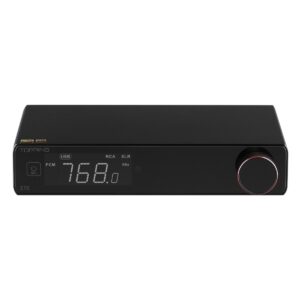
What the Topping E70 gets right immediately is focus. It fully commits to being a high-performance desktop DAC designed to sit cleanly between digital sources and an amplifier or active speakers. That clarity of purpose shows in both its layout and its sound.
At the core of the E70 is ESS’s ES9028PRO SABRE DAC, a chip that has earned a reputation for precision and consistency when properly implemented. Topping pair it with a clean, low-noise output stage and careful clocking, allowing the E70 to support PCM up to 32-bit at 768kHz, native DSD512 over USB, and a wide range of Bluetooth codecs, including LDAC.
Measured performance is excellent, and it translates into a presentation that feels controlled and transparent rather than clinical. It’s also natural-sounding, revealing speakers or amplifiers where you want the DAC to stay out of the way.
Flexibility is handled quietly but effectively. USB, optical, and coaxial inputs make it easy to integrate into everything from a laptop-based system to a CD transport or TV. On the output side, you have balanced XLR and single-ended RCA connections, letting the E70 slot into minimalist desktop setups or more traditional hi-fi systems without adapters or workarounds.
A small but welcome touch is the inclusion of 12V trigger input and output, which makes system automation straightforward at this price. An intelligent auto on and off function rounds things out, helping it disappear into daily use.
7. Mission LX Connect DAC
 Key features
- ESS Sabre 9018 DAC
- Bluetooth connectivity
- Roon compatibility
Pros
- HDMI Connection for use with TV setups or high-bandwidth connections from laptops
- Built-in pre-amplifier that offers 100Ω impedence, and full 20Hz – 20KHz bandwidth
- Compact enough to blend in and hide in more elaborate systems or work well for desktop PC setups
Cons
- Only outputs are RCA
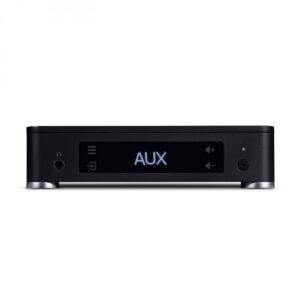
Rather than chasing extreme measurements or ultra-minimalist design, the Mission LX Connect DAC is built around the idea of bringing everything together. It’s designed to act as a genuine system hub, pulling multiple digital and analogue sources into one compact unit while keeping operation simple and approachable.
That mindset makes it especially appealing for mixed-use setups that include TVs, streamers, and traditional hi-fi sources.
Mission have equipped the LX Connect with an ESS Sabre 9018 DAC for a clear, realistic audio performance. It supports PCM up to 32-bit at 384kHz over USB, along with DSD playback and a range of digital filter options that allow subtle tuning of the presentation. Bluetooth is built in for wireless playback, and Roon compatibility is there if you want centralised library management or multiroom control.
System integration, however, is where the LX Connect really earns its place. Alongside optical and coaxial digital inputs, it includes HDMI ARC, making it a strong option for improving TV audio without adding complexity. There’s also an analogue RCA input, allowing legacy sources to be folded into the same control point.
The preamplifier stage provides variable RCA output, meaning the LX Connect can feed a power amplifier or active speakers directly, reducing the need for additional boxes.
8. FiiO KA17
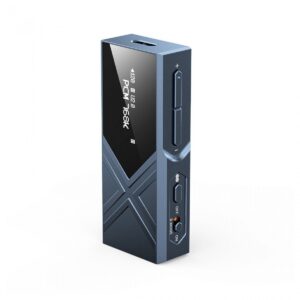 Key features
- Dual flagship ES9069 DACs
- Supports PCM 768K and DSD512 formats
- Balanced THX AAA 78+ headphone amplifier
Pros
- Clean design with compact but informative display.
- Desktop mode allows for more power draw and greater performance
- Dual USB-C ports separate extra power and data streams
Cons
- On the larger side for a “dongle” design
Pocket DACs often get treated like accessories, but the FiiO KA17 is closer to a serious headphone front end that just happens to live on a USB cable. It’s made for listeners who want real output power from a phone or laptop without committing to a full desktop stack. At around 33.5g, it slips into a pocket easily, yet feels engineered like a miniature component.
Two flagship ES9069Q DAC chips handle conversion, and FiiO back them up with an XMOS XU316 USB stage that supports full MQA decoding. High-resolution support is extensive, reaching PCM up to 32-bit at 768kHz and native DSD512. There’s also a small 0.91-inch display for key information like sample rate, gain, and volume. You then have a ten-level PEQ for precise tonal tuning.
Power delivery is where the KA17 really flexes. A balanced THX AAA 78+ headphone amplifier provides clean drive, and a dedicated Desktop Mode switch raises the output for home listening. In that mode, it can deliver up to 650mW from the 4.4mm balanced output into 32 ohms, which makes it a strong match for more demanding over-ears, while the 3.5mm output keeps things simple for everyday headphones and IEMs.
Plus, there are gain options to help it stay quiet with sensitive earphones while still scaling up when needed.
Day-to-day setup is refreshingly practical, thanks to dual USB-C ports. One handles data and power, while the second can accept extra power, helping stability when you push Desktop Mode hard. You also get a leatherette case and short OTG cables in the box, so it’s ready for travel. It’s great for anyone who wants a compact DAC and headphone amp with real muscle, clear feedback, and top-tier format support.
9. Astell&Kern HC2 Hi-Fi Dual DAC Amplifier Cable
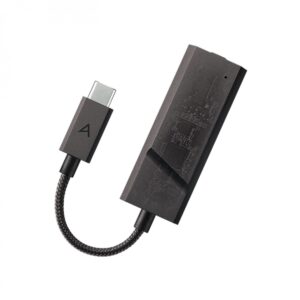 Key features
- USB-C connection
- Dual Cirrus Logic CS43198 DAC chips
- Native DSD256 and 32-bit/384kHz for high-res audio production
Pros
- Compact and portable device-friendly
- Sturdy dual-shielded braided cable
- Cirrus Logic DAC chips have high bandwidth capacity
Cons
- Only a 4.4mm output
The Astell&Kern HC2 is a great example of how far portable digital audio has come. This is a fully fledged dual-DAC headphone amplifier designed for listeners who want genuine hi-fi performance from their phone, tablet, or laptop without carrying a separate box. It’s minimalist in form, but not in ambition.
Internally, the HC2 uses dual Cirrus Logic CS43198 DAC chips, one dedicated to each channel. This dual-mono approach helps maintain channel separation and keeps noise and distortion impressively low for something this compact.
High-resolution support is properly modern, with PCM up to 32-bit/384kHz and native DSD256, meaning it can take full advantage of high-quality streaming services and local hi-res libraries alike. The USB-C input makes it natively compatible with most modern devices, while the 4.4mm balanced output ensures optimal performance with compatible headphones and IEMs.
In use, the HC2 delivers a sound that feels controlled and distinctly Astell&Kern in character. There’s a sense of refinement and openness that many basic dongle DACs struggle to achieve. Bass is tight and articulate, mids are clear and well defined, and treble detail comes through smoothly without harshness. It doesn’t try to add warmth or colour for effect.
Plus, it’s built to last. The braided, dual-shielded cable feels robust and premium, with well-finished terminations. There’s no app, no display, and no extra controls to worry about. The HC2 is designed to disappear into your setup and simply improve the sound.
10. Topping DX3 Pro+ DAC and Headphone Amplifier
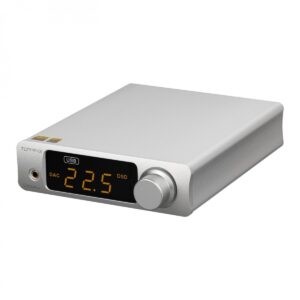 Key features
- Dual gain settings for +6dB Lo and +19dB Hi
- NFCA circuitry
- Eight core XMOS XU208 module supporting PCM32bit/768kHz and DSD512
Pros
- THD+N as low as 0.00015%
- -90dB channel cross-talk
- 29Hz-40kHz frequency range
Cons
- Navigating the menus can be a learning curve
The Topping DX3 Pro+ is a compact desktop DAC and headphone amplifier designed to deliver strong technical performance in a small, system-friendly footprint.
Conversion duties are handled by an ESS ES9038Q2M DAC, supported by an XMOS XU208 USB interface capable of PCM up to 32-bit/768kHz and native DSD512. Topping’s NFCA (Nested Feedback Composite Amplifier) circuitry is used in the headphone stage, resulting in extremely low distortion and noise levels, even with sensitive headphones.
Two gain settings allow the DX3 Pro+ to accommodate a wide range of loads, from efficient IEMs to more demanding over-ear designs.
Connectivity is straightforward but well judged. USB, optical, and coaxial digital inputs cover most common sources, while Bluetooth 5.0 with LDAC, aptX HD, aptX LL, AAC, and SBC provides a practical wireless option. Analogue output is via RCA, and the unit can be used either as a fixed-output DAC or as a variable-output preamp feeding an external amplifier or active speakers.
In sonic terms, the DX3 Pro+ follows a neutral, low-colouration approach. And it’s easy to operate thanks to a clear front display, compact chassis, and remote control.
11. iFi Zen Air Blue
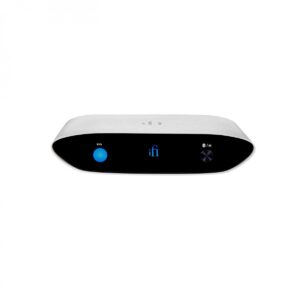 Key features
- Supports Bluetooth 5.0TM with SBC, AAC, aptX, aptX HD, aptX Adaptive, aptX LL, LDAC, LHDC/HWA Codec
- Premium ESS Sabre Hyperstream DAC chipset
- TDK C0G (Class 1 ceramic) capacitors
Pros
- Compact footprint for neat, simple integration
- Improves audio quality from Bluetooth formats
- Qualcomm QCC 5100 Bluetooth chipsets (excellent quality communication chips)
Cons
- Bluetooth is the only functionality
The iFi Zen Air Blue is a purpose-built Bluetooth audio receiver. It focuses squarely on doing Bluetooth properly, and at this price point, that focus pays off.
Unlike basic Bluetooth receivers that rely on a single system-on-chip solution, the Zen Air Blue uses a separated Bluetooth and DAC architecture. A Qualcomm Bluetooth chipset handles wireless reception before passing the signal to an ESS Sabre DAC, supported by iFi’s Time Domain Jitter Eliminator and discrete clocking.
This approach helps reduce jitter and noise, allowing the unit to deliver a cleaner, more stable conversion than standard Bluetooth adapters. Analogue output is via RCA, making it easy to integrate with amplifiers, active speakers, or powered desktop systems.
Codec support is also great. The Zen Air Blue supports SBC, AAC, aptX, aptX HD, aptX Adaptive, aptX LL, LDAC, and LHDC, ensuring compatibility across Android, Apple, Windows, and modern streaming devices. In practical terms, this means you’re not locked into a single ecosystem, and you can take advantage of higher-quality Bluetooth streams where your source allows it.
The only downside is that sonically, it won’t outperform a good wired USB DAC at this price. But for Bluetooth playback, it performs confidently and consistently.
12. Topping D10
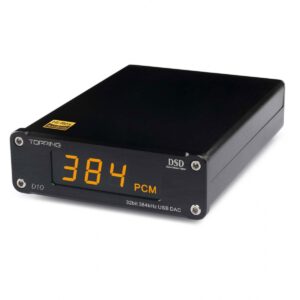 Key features
- USB for data transfer and power
- Supports 384 kHz PCMf
- Swappable OP amp (only get into this if you know what you’re doing)
Pros
- It can be used as a desktop DAC, powered and used with a laptop or PC as the source
- Digital outputs for use as a USB interface for other external gear (futureproofing itself)
- Very clear display
Cons
- Only a USB input
The Topping D10 is a stripped-back, USB-powered desktop DAC built for one job: taking audio from a computer, or other USB source, and outputting a clean analogue signal with as little fuss as possible. It’s a simple, affordable way to upgrade the DAC stage in a laptop, PC, or tablet-based setup.
Format support is solid for the money, with PCM up to 384kHz and DSD256, covering the vast majority of hi-res libraries and streaming use cases. Connection is USB-only, which keeps things simple and makes it ideal for a desk system where the computer is the main source. It’s also USB-powered, so you’re not adding another power brick to the setup, and in most cases, it’s a straightforward plug-and-play experience.
The key advantage here is in the outputs. The D10 Balanced provides balanced analogue output, which is useful if you’re feeding active monitors or a balanced-input amplifier and want improved noise rejection compared to typical single-ended runs. That alone can make it a very tidy solution for desktop audio, especially in environments where USB noise and cable routing can become a headache.
One of the more practical long-term benefits is that the D10 can continue to be useful even if your system grows. If you later move to a larger DAC or different configuration, the D10 can still act as a USB interface or converter in the chain, rather than becoming redundant.
DAC connections explained
USB is the most common input on modern DACs, primarily used to connect computers, phones, and tablets. It also supports the highest-resolution audio formats, including high sample-rate PCM and native DSD. You’ll tend to see it as a USB Type-B socket on desktop units or USB-C on portable DACs.
Optical, also known as Toslink, uses a square socket with a small flap and transmits audio via light. It is commonly used for TVs, games consoles, and CD players. Optical is electrically isolated, which helps avoid noise, but it’s usually limited to lower maximum sample rates than USB.
Coaxial digital inputs look like a single RCA socket, often coloured orange. They carry digital audio over a copper cable and are frequently found on CD transports and older hi-fi components. Coaxial typically supports higher sample rates than optical, but does not provide electrical isolation.
HDMI ARC is less common on DACs but increasingly useful. It uses a standard HDMI socket and allows audio to be sent directly from a TV to a DAC. This makes it ideal for improving TV sound while still using your existing speakers or amplifier.
Bluetooth removes cables altogether and is used for wireless playback from phones and tablets. Sound quality depends heavily on codec support, with LDAC and aptX HD offering better performance than standard SBC.
RCA connections are the most common analogue output and are used to feed amplifiers or active speakers. These are your classic red and white connections; remember “red for right”.
XLR outputs look similar but use three-pin connectors and provide a balanced signal, which is better for longer cable runs and improved noise rejection.
Some DACs also include 3.5mm or 4.4mm headphone outputs, allowing direct connection to headphones without a separate amplifier.
How to choose the best DAC under £500 for you
Choosing the best DAC under £500 starts with one question: what job do you need it to do? “Best” is not universal at this price, because designs range from tiny phone dongles to desktop units built to live in a system.
Begin with your main purpose. If you want something portable for commuting, travel, or moving between laptop and phone, a compact USB DAC and headphone amp makes sense, because it draws power from the source and slips into a pocket. In that scenario, a larger desktop unit such as the Audiolab D7 is not the right product, even if it offers more connections.
If you want a DAC to stay in place as a permanent fixture, though, a small dongle option like the Astell&Kern HC3 can feel too dependent on your phone and too limited on inputs.
Next, list the sources you need to connect. Computers benefit most from USB. TVs and consoles usually need optical or HDMI ARC. CD players and transports may use coaxial. If you plan to feed an amplifier or active speakers, confirm the outputs you need. RCA is the standard analogue output, while balanced XLR is useful for longer cable runs and better noise rejection.
Then consider headphone requirements. Some DACs are line-out only, while others include a headphone stage with gain settings and sometimes balanced outputs. Match this to your headphones’ impedance and sensitivity, and check you have the socket you prefer, such as 3.5mm, 6.35mm, or 4.4mm.
Finally, think about the features you will use. Bluetooth can be a big convenience win, filters and EQ can fine-tune tone, and remote control or auto power can make daily use easier. Pick for your setup and habits, and the right “best” becomes clear.
FAQs
Do high-end DACs sound better?
High-end DACs often reveal more detail, providing better power and cleaner circuits aid clarity. However, as we’ve listed above, “better” doesn’t always mean more expensive – there are plenty of great-quality DACs under the £500 mark.
Who makes the best DAC chips?
ESS and AKM lead the charge when it comes to DAC chips. Sabre and Velvet chips are also widely respected.
What is the best DAC for the money?
The best value for money DAC depends on what you need to use it for, but I would recommend the Chord Electronics Mojo 2 and the Audiolab D7.
Final thoughts
So there you have it, another list wrapped up. DACs aren’t the most exciting topic in hi-fi, and discussions around them can quickly turn into alphabet soup: chip names, clocking systems, wireless standards, and specs that don’t always translate clearly into real-world listening.
As these picks for the best DACs under £500 have shown us, the era of needing to spend silly money for a genuinely good DAC is well behind us. Modern designs have levelled the playing field in a big way.
If there’s a clear benchmark, the Chord Mojo 2 still sits comfortably at the top. Its predecessor held that position for years, and the Mojo 2 feels well placed to do the same, making it an easy and justified number one.
Ultimately, though, specs only go so far. Unless you’re deeply familiar with DAC architectures, your best move is to listen. Head into our showroom if you’re close by, try a few through a system you know, and see which one grabs you. On paper, they can look very similar. In practice, the right one tends to make itself obvious.






0 Comments