

Have you ever wondered what surround sound is and why so many people choose to upgrade their home setup to include it? And do you really need all those speakers and electronics to enjoy it?
Surround sound has become a key part of modern home entertainment, designed to create a more immersive listening experience by placing sound all around you rather than just in front. Whether you’re watching films, playing games, or listening to music, it can make audio feel more realistic and engaging.
Below, we give you the lowdown on what some of it means, how it works, and why speaker positioning is so important. So, without further ado, let’s get started.
What is surround sound?
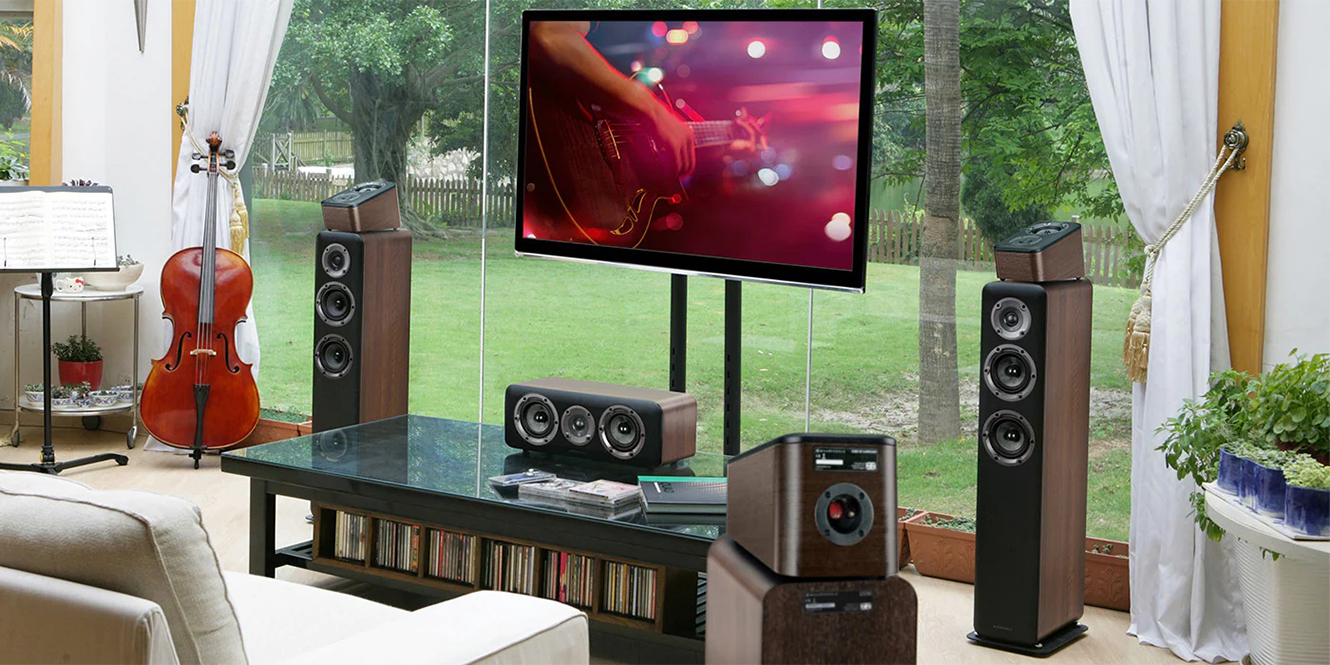
In a nutshell, surround sound is a system of at least six individual speakers (5.1) strategically placed around a central seating or sofa area. Each of these speakers delivers specific audio cues to enhance what you see on screen, helping to create a more immersive experience.
The core of any surround sound speaker setup consists of three front speakers positioned around the screen, along with two speakers placed behind your seating position.
Alongside these is the low-frequency effects (LFE) channel, which provides a dedicated signal for an active subwoofer, helping to bring those ultra-low frequencies to life in the room.
With more modern, performance-focused surround sound configurations, systems can scale up to around 7.4.6 in the home (core.sub.atmos). This means using up to 17 individual speakers, each with a specific role, all working together to enhance the on-screen experience.
So, what does 7.4.6 mean? The “7” refers to the core ear-level speakers used around your room, the “4” indicates the number of subwoofers handling those ultra-low frequencies, and the “6” represents the additional speakers used for Dolby Atmos.
These Atmos speakers are positioned above ear level, either installed in the ceiling or angled upwards to reflect sound off it. This adds a sense of height, allowing sound to move more freely around the space and creating a more immersive, three-dimensional listening experience.
How does it work?
The core speakers at ear level do most of the work, allowing our brains to match audio cues with what’s happening on screen, or even what’s about to happen, depending on where the sound is coming from. This creates a clear sense of positioning and depth, helping us feel more connected to the movie.
The subwoofer is different, as our brains aren’t very good at pinpointing where ultra-low frequencies come from. If a subwoofer is poorly positioned, you may start to notice a boomy or uneven sound in the room. The more subwoofers you use, though, the more balanced those ultra-low frequencies also become.
To experience surround sound at its best, you have to use all the core speakers with at least one subwoofer. Traditional speakers struggle to reproduce those ultra-low frequencies, meaning you can miss out on elements of the sound that were intended by the sound engineers.
Height speakers are a slightly different case, as our ears aren’t particularly good at picking out sounds from above without visual cues, unless they’re directly overhead. While we can still sense general ambience, it’s much harder to perceive precise, focused sounds without something happening on screen to guide us.
By the time a sound is directly above us, the moment has often already passed, which is why these channels work best when supporting what we see, rather than acting independently.
A helicopter flying overhead is a good way to illustrate this. We’ve all experienced those few moments where our brains try to figure out where the sound is coming from. Once we actually see it, our brains do an amazing job of locking onto the sound and focusing on the Doppler effect.
Thankfully, unless the sound engineer wants you to search for the helicopter, there are always these important visual cues on screen, helping us map out what those object-based speakers are doing. And this is why it’s important to position the speakers correctly in the room – to maximise everyone’s enhanced experience.
5.1 vs. 7.2.4 vs. Dolby Atmos
As mentioned above, a 5.1 system is the minimum speaker configuration you can have to properly decode surround sound from a compatible amplifier. It uses five full-range speakers, positioned in the centre, front-left, front-right, and two behind the listening/watching position, and a subwoofer.
It’s possible to run a system with fewer core speakers or without a subwoofer, but this is typically handled using a phantom setup. In these cases, the missing channels are blended into the remaining speakers, which can still deliver a reasonable result in less-than-ideal conditions and provide an effective surround sound experience.
One brand approached this differently for a time: Yamaha, with its Digital Sound Projector (YSP) technology. By using phasing and time delays to bounce sound off walls, this technology created an effect that felt like true surround sound, without the need for multiple visible speakers beyond the soundbar itself. However, it did require the right type of room to work effectively.
As for audio formats, 5.1 was first defined in 1987 by Tomlinson Holman, although its origins can be traced back to 1979. Since then, it’s evolved through various formats, from Dolby Pro Logic to Dolby Digital and DTS, where standard 5.1 audio typically maxed out at around 640 kbps.
With a 7.2.4 setup, the most obvious difference compared to 5.1 is simply the number of speakers. This also means that you can’t use a conventional surround amplifier; you’ll need one with 13 channels, all of which must be usable for surround sound and not as extra zones.
However, there’s a bit more to it, as these systems have to work harder, especially when using older formats like DVD. This type of media simply doesn’t contain enough audio data for AV receivers to fully utilise every speaker in a larger setup.
To address this, many systems now use upmixing technologies such as Dolby Surround or Neural:X, which distribute sound across the additional channels so that no speaker is left unused, if you choose to enable it.
Dolby Atmos brings something different and doesn’t work within the limitations of a traditional 5.1 setup, so a reduced mix has to be used in those cases, as there are specific certification requirements that need to be met.
However, modern AV receivers can still make use of the higher bandwidth available by running Atmos in a phantom mode, allowing some of its benefits to be experienced even without dedicated Atmos speakers in a user’s setup.
Dolby Atmos also introduces object-based audio, allowing for more precise placement of sound within a space. It supports more advanced configurations, such as 7.2.4, which are commonly found on many Blu-ray discs and some streaming services. This means compatible devices with a Dolby Atmos logo can access and reproduce these more detailed audio formats.
Should I go for a surround sound system?
If you really want to create a cinema experience at home, then yes, you should absolutely create a surround sound system! We recommend something like the JBL 1000Mk2 7.1.4 Soundbar setup; it’s great for anyone who cannot use a full separates surround sound system.
However, if your room won’t accommodate a soundbar or a full system, a simple stereo setup might be the best option. This can be achieved using a stereo receiver with HDMI connectivity and a pair of speakers, offering a straightforward but effective listening experience.
If you are considering a surround sound system, the two main things to consider are whether you can position the TV centrally along the wall and whether you can move the main listening position (MLP) away from the rear wall.
If you can only reposition the TV, and the MLP remains against the back wall, a 5.1 or even 5.1.2 setup will still work well. However, if you can adjust both, you’ll be able to take full advantage of object-based systems like 7.2.4, as the rear surround speakers and at least one pair of Atmos speakers need to be placed behind the seating area for the effects to work correctly.
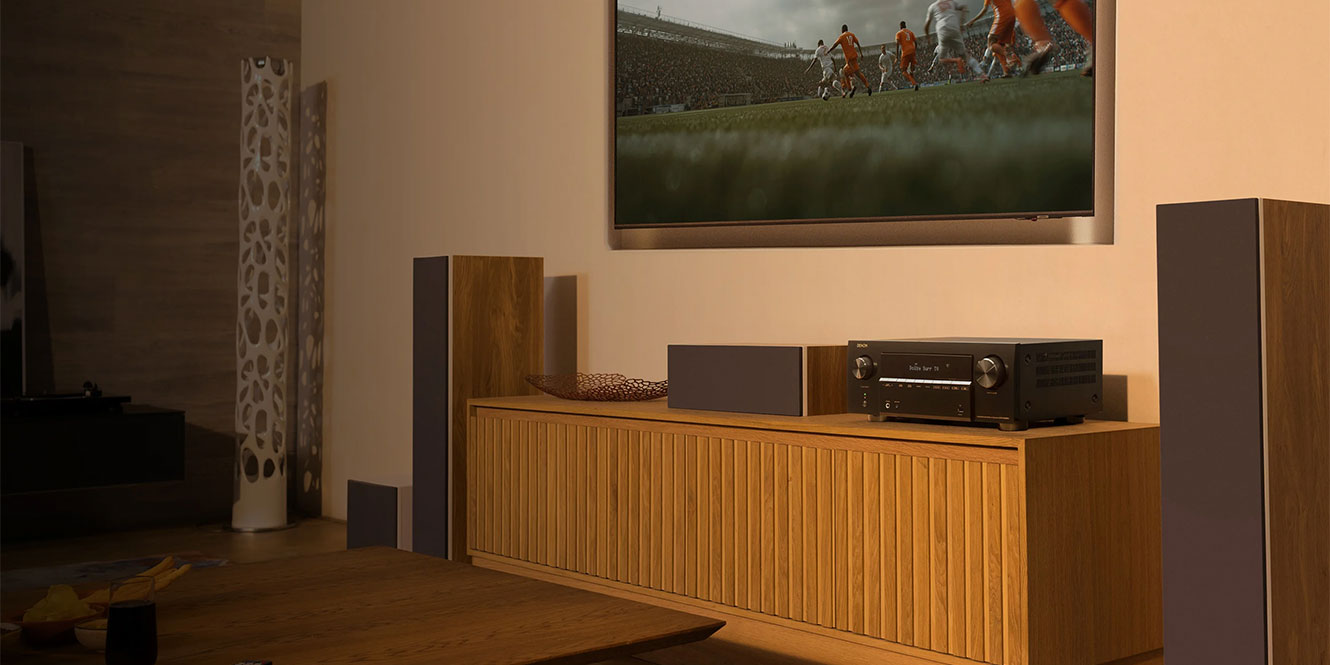
If you’re considering a separates system, you’ll also need space for a dedicated AV receiver and its associated devices, such as a Blu-ray player or set-top box. If you’re using a large TV with an AV receiver and want to access built-in streaming features, it’s worth checking for HDMI eARC support, along with Dolby Surround compatibility on both devices, as this ensures access to the appropriate audio formats.
In reality, most rooms can accommodate some form of surround sound system. One important factor to keep in mind, though, is the overall size of the room. Larger spaces will require more capable electronics with enough power to fill the area effectively, as every system has its limits, regardless of how many speakers are in use.
Looking for the right setup for you? Check out our guide to the best surround sound systems.
FAQs
What does surround sound do?
Surround sound should engulf you in the movie or music, making it feel like you’re right in the action, with sound coming from different directions.
What is 5.1 and 7.1 surround sound?
A 5.1 system consists of three front speakers, two rear surround speakers, and a subwoofer. A 7.1 setup builds on this by adding an extra pair of surround speakers, providing more detailed rear audio and a greater sense of space.
Is surround sound good for gaming?
Surround sound is great for gaming. It enables the action to sound more focused, centralising you in the heart of the game.
Final thoughts
We hope you’ve found this article useful and that our explanation of surround sound has given you a clearer understanding, especially if you’ve been unsure about how many speakers to choose or whether a soundbar will be enough for your setup!







0 Comments