
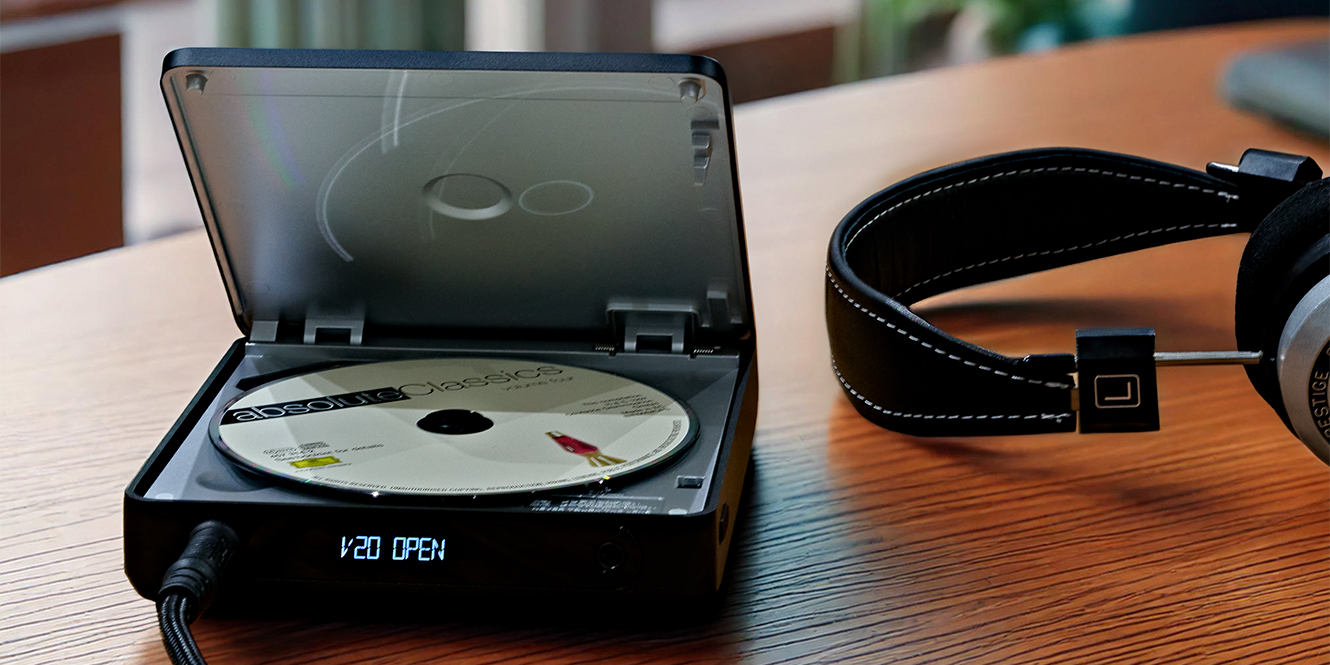

Remember the ’90s? Me neither, but I sure do remember the ’00s and growing up with a portable CD player. I remember getting one for Christmas one year and being too shy or awkward to open it or use it for months. To this day, I couldn’t tell you why. Still, I do remember when I finally got around to using it, it was such a gateway to new, exciting things.
I would often ask to borrow from my brother’s extensive CD collection, before scurrying off back to my room, listening to whatever treasures I’d dug out.
Simpler times.
Well, for the past week, I’ve had the chance to relive the glory days of 2004-09 by actually sitting down to listen to CDs for the first time in forever. I used the FiiO DM13 portable CD player with Bluetooth, and I even made the effort to visit my brother and borrow his CDs again to complete the nostalgia trip, and let me tell you, I’ve had a great time.
In this FiiO DM13 review, I’ll take you through my impressions of the player, its sound and overall performance, and any areas where the device falls short.
In a hurry? Here’s our verdict
In one word… Nostalgia.
This is a really cool portable CD player, the kind that CD players of the past wanted to be.
The sound quality from something this compact, operating on mechanical principles, is awesome. The built-in DAC and headphone amp perform excellently, driving all of my headphones perfectly well – from my most demanding over-ears to the easiest IEMs.
Another major advantage is that the anti-skip feature actually works, unlike the players from the ’00s. You can even use it as a dedicated compact desktop CD solution by taking a digital output for use with other gear. So if, like me, you’re very limited on space, it can be integrated into a setup with minimal footprint.
| Pros | Cons |
|---|---|
| Rechargeable battery, with eight hours of life (no more AAs) | It's still a little too big to carry around in a pocket |
| Anti-skip is very effective at its job | The hinge doesn’t feel the nicest |
| The built-in DAC sounds great | |
| The built-in headphone amp keeps up with some reasonably demanding headphones | |
| There's a digital output, should you wish to use it in a CD transport-type setup |
How I tested the DM13
To test the DM13, I borrowed a dozen or so CDs from my brother and used it in both portable and desktop modes. In portable mode, I did what I always used to do: sit reading at night with it playing through headphones, alternating between my Beyerdynamic and Ollo headphones, depending on what I was in the mood for.
When I was out and about, I used the player with the Shure SE215s – thankfully, I have one coat with a pocket big enough to carry it around comfortably.
In desktop mode, I took the digital output and ran it into my Naim/Focal setup, using it purely as a transport. I had access to the Bluetooth version of the player, so I also tried pairing it with my AirPods as well as an old pair of Bose headphones I had lying around.
CD-wise, I went through some nostalgic picks – MJ, Linkin Park, Slayer, Sade – to give it a fair run across genres and sounds, just to see how it fared.
FiiO DM13 Portable CD Player review
First impressions
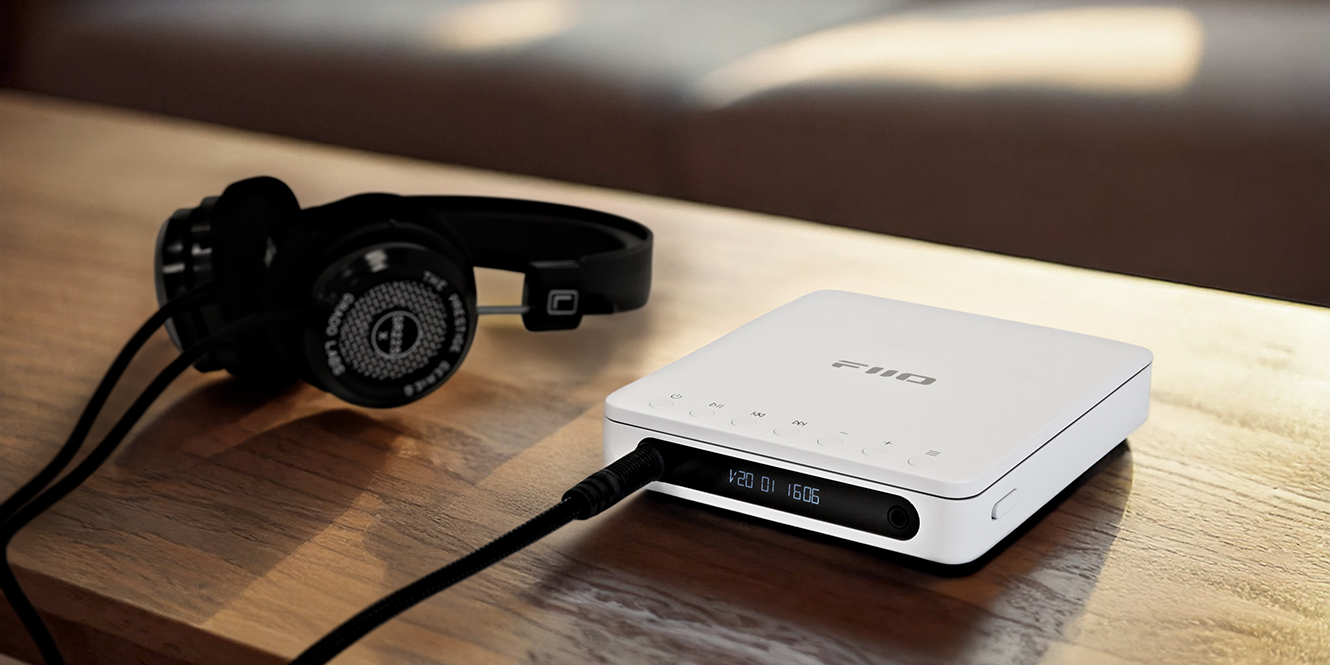
 First impressions are important, and the little FiiO delivers. It has a nice weight to it, the buttons have a satisfying feel considering they’re relatively flat, and the overall build quality is nice and sturdy.
Upon opening the CD tray lid, the only downside I noticed was that the hinges that support the top aren’t the most reassuring. But this is a very thin piece of kit, so I’m not sure how FiiO would solve this problem. It’s not the best aspect, but I also have no real qualm with it.
Powering it up, the screen is minimal, but again, it tells you everything you need to know. It treads the line between function and form very nicely.
Performance
The performance of the DM13 is pretty great. I won’t keep comparing it to old-school versions, but as I’ve said, this is pretty much the CD player that its ’90s and ’00s counterparts wished they could be. Admittedly, it is more expensive – but it appears that is the cost of idealism, and to be honest, it’s a pretty reasonable price for what it is.
I’d liken its audio performance to that of something much larger and more stationary. The dual Cirrus Logic DACs do an excellent job decoding CD information, and the laser tracking of the CD is spot on – so if you’re using it as a transport, you know that whatever other gear you use will be supplied with some excellent source information.
Connectivity
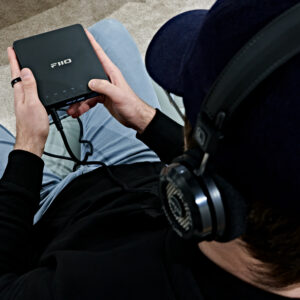 The DM13 has more connectivity than you would expect for a little thing like this. Of course, there’s the usual 3.5mm jack (we all expected this one), but you then get a balanced 4.4mm jack and a single-ended 4.4mm jack, allowing you to connect some niche headphones or use the balanced out for external gear that accepts a balanced input.
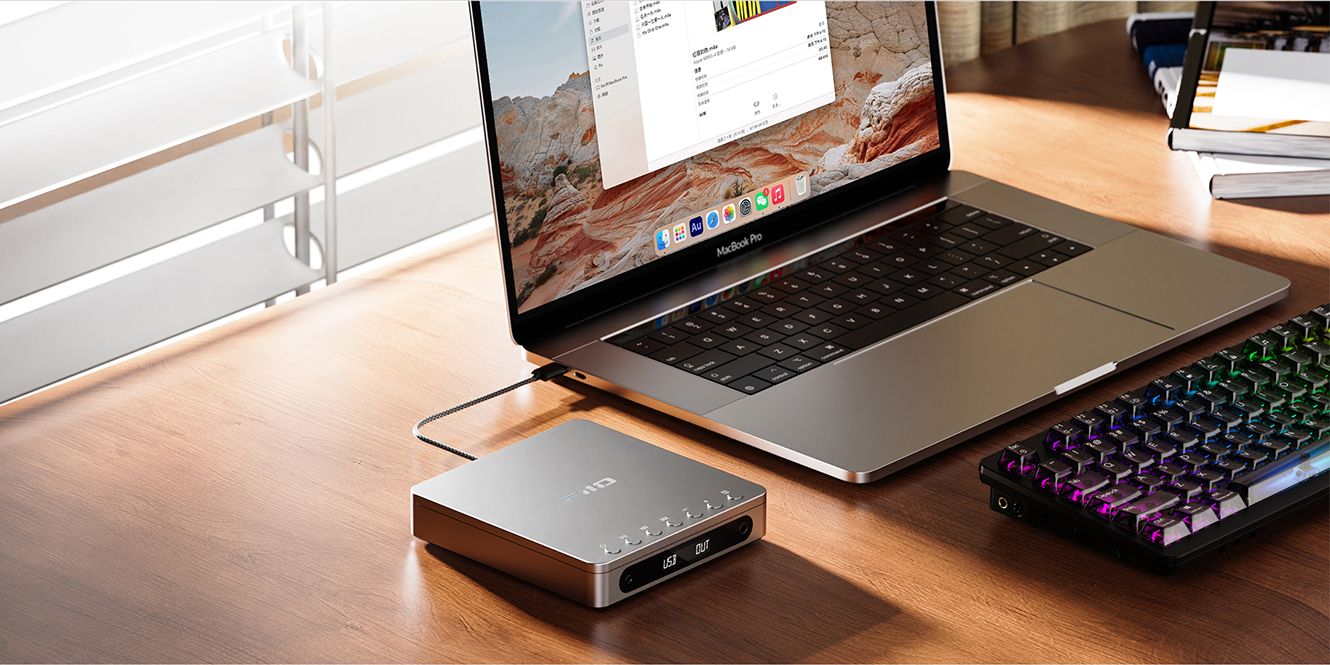
A big thing for me personally is the desktop mode, where you leave the device powered and use it either as a CD transport or a CD ripper. The fact that it’s powered via a USB-C connection rather than an obscure PSU is a major win, as it adds a lot of convenience.
With everything increasingly standardised around USB-C where possible, this feels like a solid step in the right direction. The only potential drawback is that not everyone has fully transitioned to a USB-C ecosystem yet, which might be inconvenient if you’re still using the more common USB-A connections.
As for the optical output, it uses a 3.5mm barrel-pin type connector rather than the usual trapezoid-shaped TOSLINK style. It’s a bit of a rogue choice, but given the slim form factor, I can’t really hold it against them.
Bluetooth is a welcome addition, too. By the nature of the format, you don’t get the full bandwidth of CD quality due to how compression works, but the connectivity option is nice to have included. But if you aren’t fussed about the Bluetooth function, there is a “regular” non-Bluetooth version.
Who is the FiiO DM13 suited to?
If you’ve ever caught yourself missing the ritual of picking an album, opening a case, and committing to listening to the whole thing rather than skipping through songs, the FiiO DM13 is very much for you. It’s aimed at people who want to step away from streaming for a bit and reconnect with music as a physical thing, whether that’s revisiting a CD collection you already own or starting to build one again.
It also makes a lot of sense if you listen with headphones most of the time. If you commute, read, or just like sitting with music in the evening, the DM13 gives you a distraction-free experience that feels deliberate in a way phones rarely do. No notifications, no buffering, no algorithm nudging you elsewhere.
Ultimately, this is for anyone who wants their listening to feel intentional again, without sacrificing modern sound quality or convenience.
FiiO DM13 BT specifications
Warning, there are a lot of them, and honestly, you don’t need to know or understand the technical information, but it’s there if you want it. If you’re not a fellow mega nerd, feel free to skip ahead.
| Hardware platform | Main Control: CS6137 Op-Amp: SGM82622 DAC: CS431982 |
| Output modes | PRE OUT / USB OUT / SPDIF OUT / BLUETOOTH OUT |
| Bluetooth Transmission | Supports SBC, aptX, aptX Low Latency, aptX-HD |
| Screen | 1.5-inch LCD display |
| Playback Support | CD, FLAC, WAV, WMA, AAC, MP3 |
| Power supply | Supports DC 5V / ≥2A |
| Charging time | Approximately 2.5 hours (using 5V 2A adapter) |
| Product size (W x D x H) | Approx. 137.5 x 144.7 x 28.7mm |
| Weight | Approx. 450g |
| Load | 32Ω |
| Controls | Power button Play/Pause button Previous track button Next track button Volume down Volume up Function select button |
| USB interface | 2 x USB Type-C (1 x Power in, 1x USB audio for charging and data transfer) |
| Headphone output interface | Standard 3.5mm jack |
| Single-ended line output interface | Standard 3.5mm jack |
| Balanced output interface | Standard 4.4mm jack |
| Balanced line output interface | Standard 4.4mm jack |
| Coaxial/optical output interface | Standard 3.5mm jack (shared with LO port) |
| Battery life | ≥10 hours |
FAQs
How long does it take to charge the FiiO DM13?
The FiiO DM13 takes around two hours to charge from empty to full. It charges over USB-C and gives roughly eight hours of playback.
What is the “D mode” on the FiiO DM13?
“D mode” on the FiiO DM13 is Desktop Mode for fixed use. It bypasses the battery, so you can use it as a powered CD transport.
Does the FiiO DM13 have Bluetooth?
The “regular” FiiO DM13 does not support Bluetooth, but the DM13 BT – which I reviewed here – does. It lets you listen wirelessly when cables are not practical.
Final thoughts
So here we are. Having read through my ramblings in this FiiO DM13 review, hopefully you can see why it’s not just a cool little nostalgia piece, but also a genuinely credible desktop solution, offering a surprising amount of functionality for something so compact. Beyond its main purpose as a portable player, the bottom line is that it’s pretty impressive for what it is.
If there’s one thing to take away from this – aside from the fact it has an insanely detailed spec sheet – it’s that this is a genuinely interesting bit of hi-fi kit that’s worth paying attention to. Whether you’re using it as a CD ripper or transport, taking it on the go, or integrating it into a larger system, the FiiO DM13 has its place.
I put on a Sade Greatest Hits CD and, for a moment, I was back in Venice. Early morning. Sitting in St Mark’s Square as the sun crept up over the bay. Espresso in hand. A cigarette is burning slowly between my fingers. A waiter wandered over and asked how the pastry was. I told him it was lovely. I hadn’t taken a bite.
I crossed my legs, leaned back into a chair that was worn but somehow perfect, and listened as church bells chimed in the distance, calling people to Sunday prayer. I remember thinking, This is the life. A beautiful, romantic, utterly impractical life.
Then they asked for the DM13 back.




0 Comments